|
Thanks to everyone who participated in this week's Food History Happy Hour! In this episode we made the Ice-Cream Soda-Water from Cooling Cups and Dainty Drinks (1869). As I went through the laborious process of hand-shaving ice from a block, we briefly discussed the history of ice harvesting and the first uses of soda fountains.
We also discussed all things hot dog! Including the history of hot dogs, how they are made, their prevalence at beaches, ball parks, and fairs, regional variations in hot dog toppings, the origin of the corn dog, and the use of hot dogs in American diplomacy, including famously by Franklin D. and Eleanor Roosevelt in Hyde Park when they entertained King George VI and Queen Elizabeth of Great Britain in 1939. We also discussed sweet v. savory cocktails in history, uses for leftover hot dog buns, and more. Check it out! Ice-Cream Soda-Water (1869)
In my research for last week's episode into the origins of the root beer float, I found reference in the 1860s to soda fountains and the invention of the ice cream soda that was simply ice and cream and soda water. So it was fun to discover this recipe in the cocktail guide Cooling Cups and Dainty Drinks (1869).

"Ice-Cream Soda-Water" from Cooling Cups and Dainty Drinks ((1869).
The original recipe doesn't have much direction, but here it is:
Ice-Cream Soda-Water - Equal quantity of fruit syrup and cream; double the same of shaven ice; add bottle of soda water and drink off. Here's my recipe: 1 cup hand-shaven ice (the more the better) 1 ounce raspberry syrup (a 19th century favorite!) 1 ounce heavy cream 6-8 ounces seltzer or club soda Place the ice in a large tumbler and pour syrup and cream over, top with seltzer, stir gently, and drink quickly. "Dog Factory" by Thomas Edison (1904)
A Food Historian friend asked if I was going to "ruin" hot dogs for Food History Happy Hour by discussing how they are made. I didn't make any promises, but thought this Thomas Edison film was fun to watch. In it, dogs are turned into hot dogs, and hot dogs are turned back into dogs. In the background of the "factory" - which closely resembles a hot dog push cart - ropes of sausages hang on the wall labeled by type of dog.
It's a bit gross, but meant to be all in good fun - making a joke (as always) about the origins of the meat used to make hot dogs, something that still occurs today. In the end, more sausages get magically turned into dogs than vice versa. Episode Links
This was a fun episode to research, and here are a few of the articles I referenced:
Thanks for watching!
If you liked this post and would like to support more Food History Happy Hour livestreams, please consider joining us on Patreon. Patrons get special perks like access to members-only content.
0 Comments
Thanks to everyone who participated in this week's Food History Happy Hour! In this episode we made the Flash of Lightning from the Recipes of American and Other Iced Drinks, London (1902).
For this episode we discussed the recent controversy from Goya CEO and the context and history behind Spanish culture and colonialism in South and Central America, the history of root beer and other early sodas, including ginger ale, birch beer, and sarsaparilla, the origin of root beer floats and ice cream sodas. Flash of Lightning Cocktail (1902)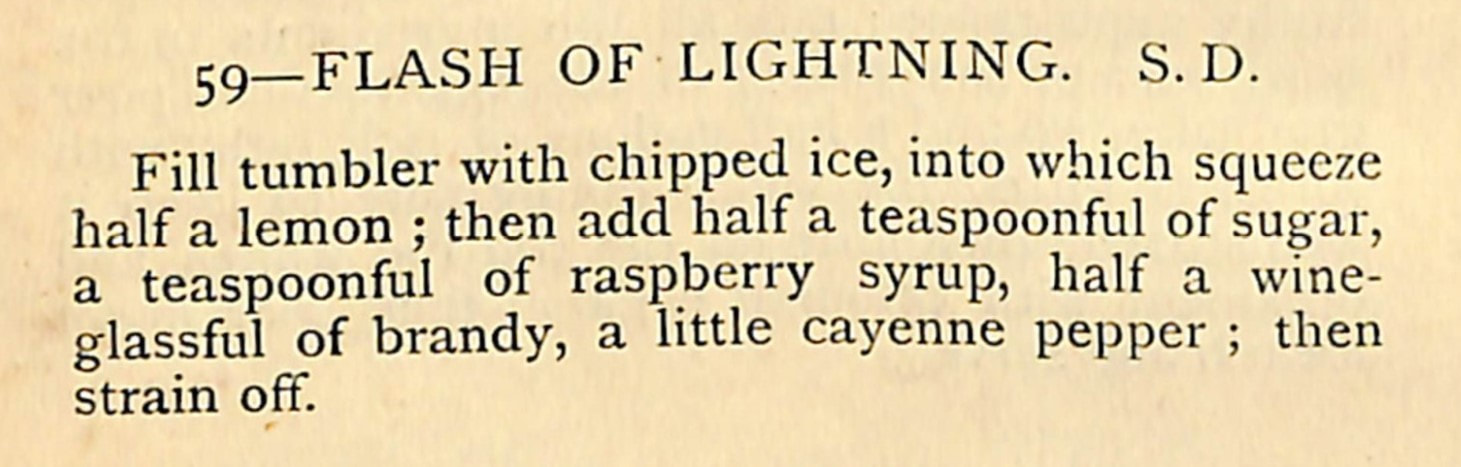
Here's the original recipe, from Recipes for American and Other Iced Drinks by Charlie Paul (1902):
Fill tumbler with chipped ice, into which squeeze half a lemon; then add half a teaspoonful of sugar, a teaspoonful of raspberry syrup, half a wine-glassful of brandy, a little cayenne pepper; then strain off. And here's my version: In a cocktail shaker over ice, add: Juice of half a lemon 1/2 teaspoon granulated sugar 1 teaspoon (or thereabouts) raspberry syrup 2 ounces cherry bounce one or two taps of ground cayenne pepper Shake then strain into wineglass. This recipe is definitely a quite sweet (thanks in part to the cherry bounce), so if you want something not so sweet, leave off the sugar. As the drink warms and sits the heat of the cayenne will intensify, so you might want to use a light hand to begin with. Episode Links
If you liked this post and would like to support more Food History Happy Hour livestreams, please consider joining us on Patreon. Patrons get special perks like access to members-only content.
Thanks to everyone who participated in this week's Food History Happy Hour! In this episode we made the Gin Daisy from the Recipes of American and Other Iced Drinks, London (1909).
We talked about Holland gin, orgeat syrup, picnics, including picnicking in rural cemeteries, potato salad, Miracle Whip a.k.a. boiled dressing, camping, including Maria Parloa's Camp Cookery, How to Live in Camp (1878) and Camp Cookery by Horace Kephart (1910) with an overview of the types of recipes and cooking they offer, and brief discussion of dehydrated backpacking foods. We did have a few issues with the new service, so apologies for pixelated, skipping, or out-of-synch video. Hopefully it won't happen again! Gin Daisy (1909)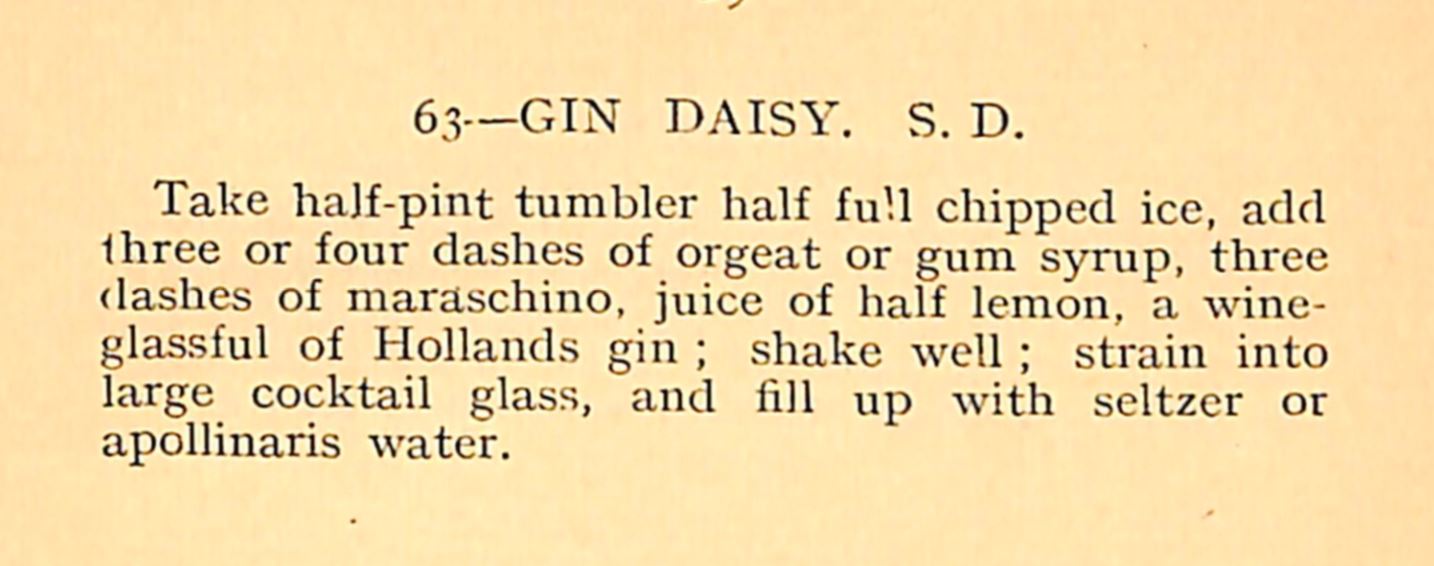
The Gin Daisy, from the 1909 "Recipes of American and Other Iced Drinks," London.
Gin Daisy from the Recipes of American and Other Iced Drinks, London (1909) original recipe:
Take half-pint tumbler half full chipped ice, add three or four dashes of orgeat or gum syrup, three dashes of maraschino, juice of half lemon, a wine-glassful of Hollands gin; shake well; strain into a large cocktail glass, and fill up with seltzer or apollinaris water. So here's my translated recipe that I used on the show: In a cocktail shaker with ice, add: 1 tablespoon simple syrup with almond flavoring 1 tablespoon maraschino syrup juice of 1/2 a lemon 1/2 wineglass gin (about 3 ounces) splash bourbon Shake and pour into a 12 ounce glass; fill with seltzer (I used lemon-lime). Add ice if desired. If I were to make this again, I would definitely cut down on the gin, but the bourbon was a very nice addition for a little bit of smooth malty flavor to approximate Holland gin, a.k.a. jenever. And I might try this recipe for a more authentic orgeat syrup. Or maybe I'll try the old-school barley kind! Related to syrups - I finally ordered raspberry syrup! So expect some cocktails that call for that in the future. More pink drinks!
If you liked this post and would like to support more Food History Happy Hour livestreams, please consider becoming a member or joining us on Patreon. Members and patrons get special perks like access to members-only content.
Thanks to everyone who participated in this week's Food History Happy Hour! In this episode we made the Saratoga Cooler from the 1917 Recipes for Mixed Drinks. We also talked about Saratoga Springs, Ann Northup, Saratoga chips and George Crum, Hand melons, watermelon and melons in general, ginger ale, root beer, birch beer, spruce beer, and other lightly fermented soft drinks, by request, my food and cooking memories, celebrating my grandpa's 101st birthday, lemon shakeups and lemonade, tomato sandwiches, Miracle Whip, tomatoes and food storage, the Soviet version of Spam, whether or not to refrigerate eggs, a brief foray into next week's topics of camping, drink pairings, and ice cream. I also asked for input on putting together new talks!
Saratoga Cooler (1917)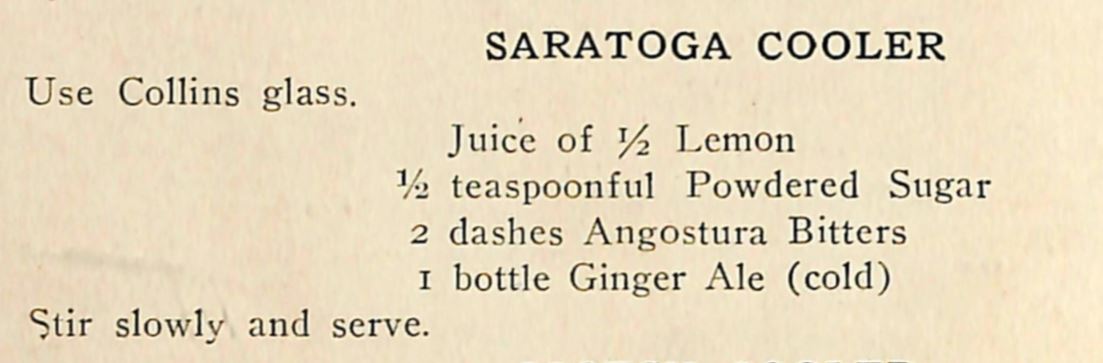
The "Saratoga Cooler" cocktail comes from the "Cooler" section of Recipes for Mixed Drinks by Hugo Ensslin (1917).
Here's the original recipe: Use Collins glass. Juice of 1/2 lemon 1/2 teasponful powdered sugar 2 dashes Angostura bitters 1 bottle ginger ale (cold) Stir slowly and serve. I used 1 tablespoon of lemon and just filled the glass with ginger ale. I also added ice to keep things nice and cold and guestimated the powered sugar. It really was quite refreshing though! 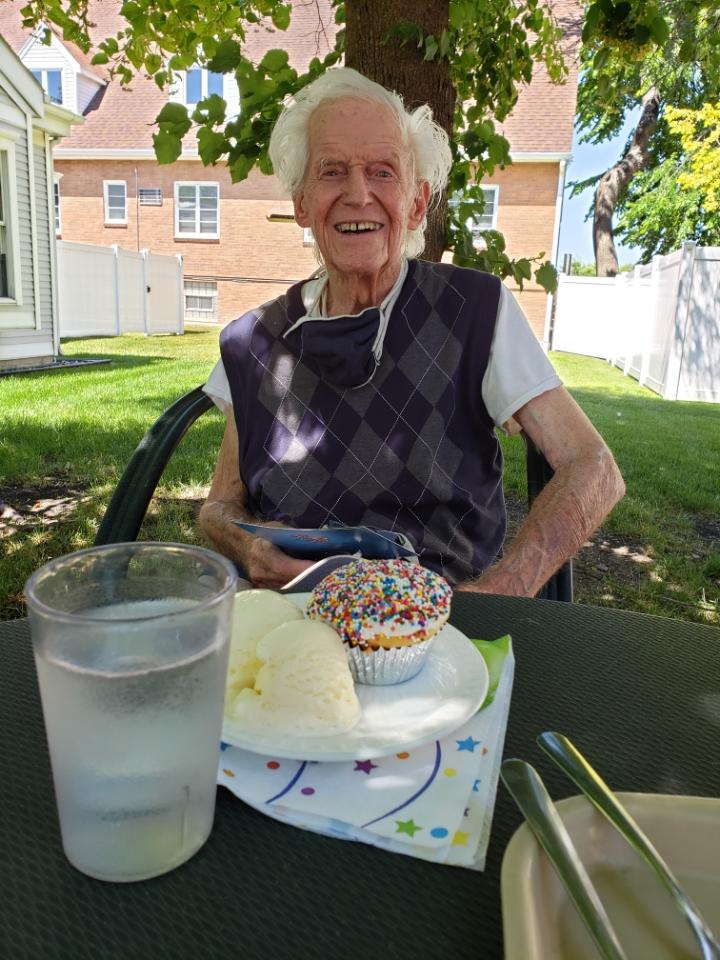
My grandpa, who was born on July 3, 1919, on his 101st birthday.
And this handsome fella is my grandfather, who just turned 101 years old. He was born on July 3, 1919. Happy Birthday, Grandpa Les!
If you liked this post and would like to support more Food History Happy Hour livestreams, please consider becoming a member or joining us on Patreon. Members and patrons get special perks like access to members-only content.
Thanks to everyone who joined us for Food History Happy Hour! This week we make the super retro, somewhat disgusting, Beef Fizz. We talk about the history of the Beef Fizz, including the history of consomme, the taste of Beef Fizz and why it's more appropriate for puppies, some background on the history and terminology of the word "cocktail" and its role as a first course, hot cocktails, a cameo by Sweetie Pie (who LOVED the Beef Fizz), tiki bars and cultural appropriation, Teddy Roosevelt and American colonialism in the Philippines and Polynesia, destructive ideas about Indigenous women and sexuality, Hawaiian and Pacific Foods (1940) cookbook, "it's safe to be hungry" in reference to electric and gas stoves, and foraging between the two World Wars, Nature's Garden for Victory and Peace (1942) by George Washington Carver, historic hunting, venison, and the modern deer population, the same with Canada geese, ecological carrying capacity, roadkill and historic consumption of wild meats, and Lent and what constitutes "meat."
Beef Fizz (1960s?)
So some Food Historian friends and patrons ALL tagged me in this social media post (below) with the recipe for Beef Fizz. It's been going around the interwebs for a while, so I'm definitely not the only one to make this on film. However, I couldn't track down what cookbook it was from.
A 1968 Campbell's cookbook DOES have a recipe for "Beef Fizz," but theirs calls for club soda, not ginger ale. So if anyone is able to find the original cookbook below, please let me know! 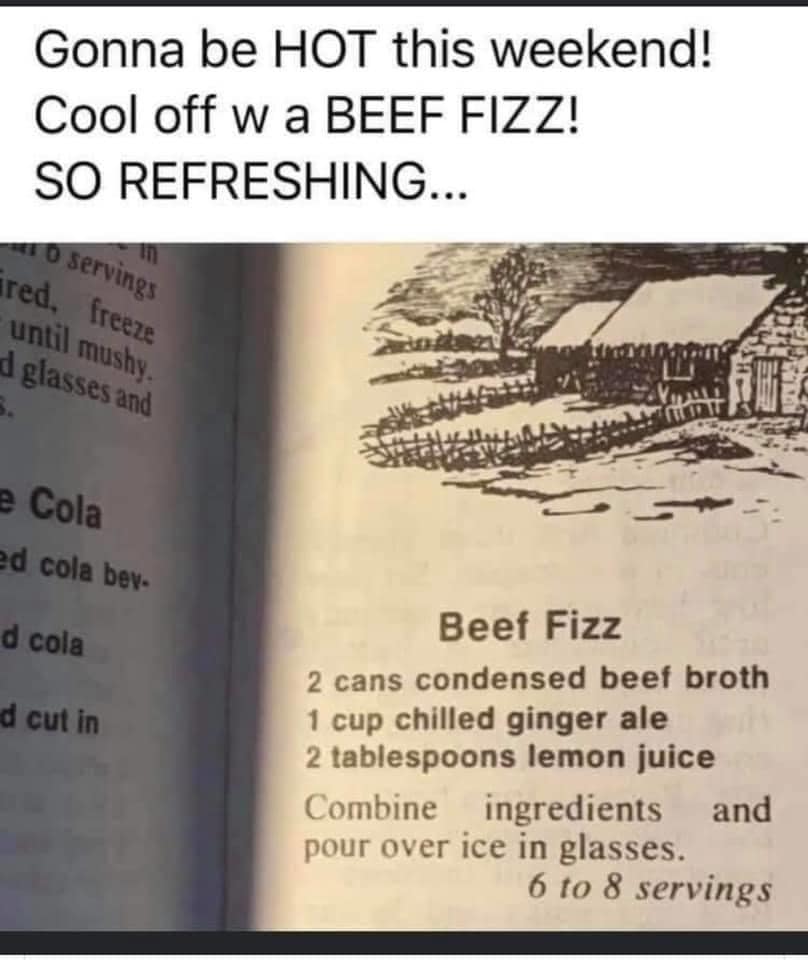
2 cans condensed beef broth
1 cup chilled ginger ale 2 tablespoons lemon juice Combine ingredients and pour over ice in glasses. 6 to 8 servings. Of course, as I mentioned in the video, I did not want to have 8 servings of this stuff, so I cut the recipe in half: 1 can Campbell's beef consomme 1/2 cup chilled ginger ale 1 tablespoon lemon juice (bottled) Poured over ice. Not as bad as I expected, but do not recommend. Think of it as cold soup, and it's sort of drinkable. Sort of. Now for the roundup of links!
A little sparse this week, but that's because there are more links up above! Happy reading.
If you liked this post and would like to support more Food History Happy Hour livestreams, please consider becoming a member or joining us on Patreon. Members and patrons get special perks like access to members-only content.
It's Juneteenth! Thanks to everyone who joined us for Food History Happy Hour. This week we make the Rose in June cocktail from the 1917 "Recipes for Mixed Drinks." We discussed Juneteenth, red velvet cake, victory gardens including propaganda and the exclusion of Black farmers and imprisoned Japanese Americans, the role of visuals in influencing taste, Black Food Historians You Should Know, disparities in book contracts, hot weather foods, salads, summer kitchens, how historical peoples coped without air conditioning, how historical peoples kept foods cold before refrigeration, ice and ice cream in the ancient world, rural electrification and electric refrigerators, the Frigidaire Cookbook, icebox pie, racial stereotypes in food advertising, including the history of the "Aunt" and "Uncle" terms, including Uncle Ben and Aunt Jemima, the history of the mammy trope, the tragedy of child caring roles, What Mrs. Fisher Knows About Old Southern Cooking, Black children in advertising, Franchise: the Golden Arches in Black America, the forthcoming book scanner I ordered, monuments and statues, and we ended with a signal boost for the James Hemings Society.
Rose in June Fizz (1917)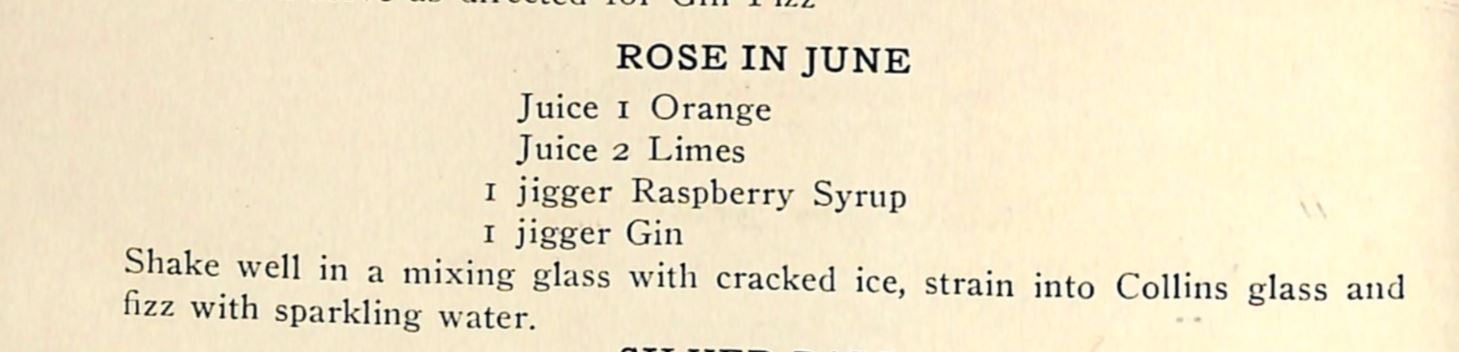
The "Rose in June" cocktail comes from the "Fizz" section of Recipes for Mixed Drinks by Hugo Ensslin (1917).
The original recipe calls for: Juice of 1 orange Juice of 2 limes 1 jigger raspberry syrup 1 jigger gin Shake well in a mixing glass (or cocktail shaker) with cracked ice, strain into Collins glass and fizz with sparkling water OR - if you don't have fresh citrus fruits OR raspberry syrup - you can substitute 1/3 cup orange juice, 1/4 cup lime juice, a heaping tablespoon of raspberry (or in my case, strawberry) jam, and the gin. Very nice, very refreshing, but sadly NOT pink.
Here's a roundup of links related to everything we talked about (in addition to all the links above!):
If you liked this post and would like to support more Food History Happy Hour livestreams, please consider becoming a member or joining us on Patreon. Members and patrons get special perks like access to members-only content.
Thanks to everyone who joined in this weeks' Food History Happy Hour! In this episode we made the Guadalcanal Cocktail and discussed rhubarb, abolitionist boycott of sugar and the slave trade, rhubarb recipes and all the animals who are eating my rhubarb, breakfast cereals, in particular GrapeNuts and the real story GrapeNuts ice cream (and its predecessor GrapeNuts pudding), graham flour and graham pudding, Kellogg v. Post cereals (as seen on The Food That Built America), including the history of Granula, the accident of corn flakes, C.W. Post and the California Fig Nut Company, sugary breakfast cereals in the 1950s and on, shredded wheat, the Victorian interest in grain-based products with milk on top, Wheatina, frog eye salad, Cool Whip, rural v. urban breakfast trends, food deserts, housing policy and suburbs, TV and dinners, the addictiveness of sugar, the food pyramid, the history of lunch, including nuncheon, and the introduction of fellow food historian Niel De Marino, who specializes in 18th century foodways and runs The Georgian Kitchen, Russian/Georgian food and cookbooks, Black Panthers, and the reaction to the film "Birth of a Nation."
With a cameo by Sweetie Pie, of course! And I believe this was our longest and most lively Food History Happy Hour yet! Guadalcanal Cocktail
1 jigger bourbon (Old Crow is most accurate)
2-3 ice cubes unsweetened grapefruit juice In an old fashioned glass, pour jigger of bourbon over ice. Fill with grapefruit juice and stir. The REAL Story of Grape Nuts Ice Cream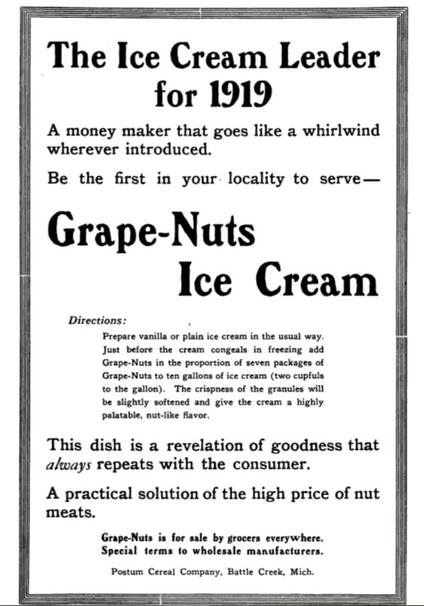
GrapeNuts Ice Cream advertisement from the "Ice Cream Trade Journal," 1919.
Well as you may know I get a lot of media requests, so one on the origin of Grape Nuts ice cream was fun to research, even if the request was VERY last-minute. Sadly, my commentary on the history did not make the cut of the rather frivolous radio spot (annoying, considering how much work I put into it, all free of charge), but it DID result in some fun research on Grape Nuts ice cream, which was, sadly, NOT invented by Hannah Young in Wolfville, Nova Scotia in 1919, as many people, including her grandson Paul, have claimed. Or at least, Hannah may have come up with the combination independently (although I doubt that could ever be verified), and likely had a hand in popularizing it in Nova Scotia, but I've found references that predate Young by at least 10 years.
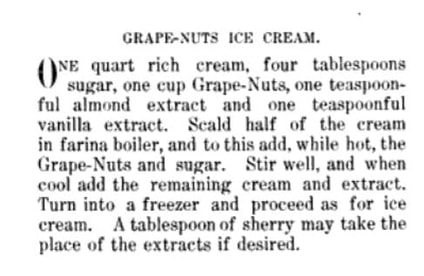
Grape Nuts Ice Cream, "American Housekeeper Advertiser," 1909.
This reference, from the American Housekeeper Advertiser dates to 1909 and is the earliest published reference I could find.
Of course, in 1916, the Post company published, "Good Things to Eat From Wellville." 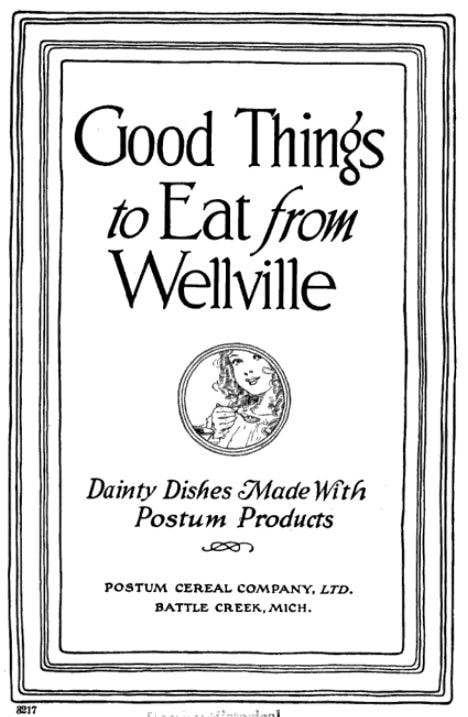
The Post company cookbook - "Good Things To Eat From Wellville," published in 1916.
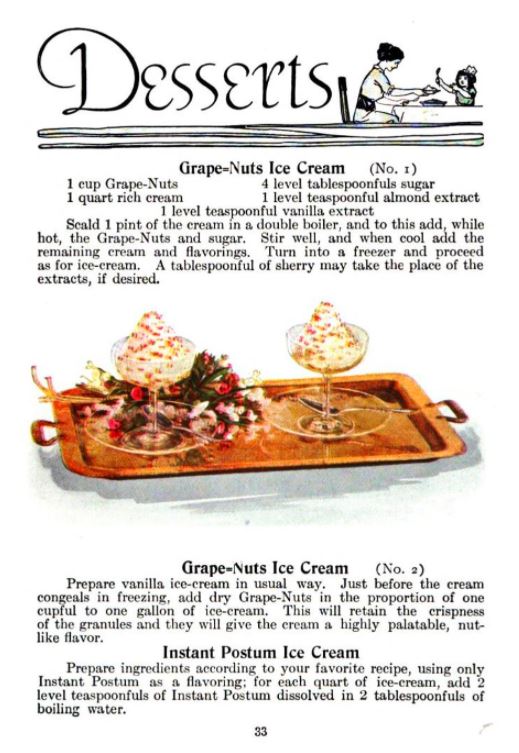
The TWO GrapeNuts Ice Cream recipes in "Good Things to Eat From Wellville" (1916).
The first recipe listed in "Good Things to Eat" is very similar to the one from the American Housekeeper Advertiser, but the second is simply vanilla ice cream with Grape Nuts folded in. Also notice with "coffee" flavored Postum ice cream! The cookbook also includes Post Toasties ice cream and several other confection recipes using the cereals. And of course, all these recipes predate the 1919 Hannah Young story.
At any rate - it was a fun research project and I'm glad I was able to add to the historiography of Grape Nuts Ice Cream.
Here's a flurry of other links related to tonight's talk!
If you liked this post and would like to support more Food History Happy Hour livestreams, please consider becoming a member or joining us on Patreon. Members and patrons get special perks like access to members-only content.
Thanks to everyone who joined me on Friday for Food History Happy Hour live on Facebook. This week we discussed the role of riots and boycotts in history and food history, touching primarily on the food boycotts and riots and high cost of living protests of 1916/1917 which occurred around the globe. We also talked about women's suffrage and farmerettes, midnight suppers, Frank Meier, inventor of the bees' knees cocktail and his role in WWII, poison candy and the Pure Food and Drug Act of 1906, food and riots or protests, including the role of food and cooking in the Civil Rights movement, Laura Ingalls Wilder and the Little House Cookbook, L. M. Montgomery, requests for next week, and a brief introduction to the history of gelatin, beaten biscuits, and other formerly upper-crust foods which became inexpensive convenience foods. If you want to watch back episodes you can check them out on right here on the blog or I am hoping to upload full episodes to YouTube now that my channel is officially verified! Bees' Knees Cocktail (1936) Bees' Knees recipe from "The Artistry of Mixing Drinks" by Frank Meier. Note the little "FM" monogram everywhere. In 1936 Frank Meier published "The Artistry of Mixing Drinks," a beautifully designed little bartender's guide based on his time as the head bartender at the Hotel Ritz Carlton's Cafe Parisian, which opened in 1921. Frank had purportedly trained at the Hoffman House in New York City before taking on his new role at the Ritz. He served as head bartender and host for over twenty years and even played a role in the French Resistance during WWII, when the Ritz became German headquarters. Meier was a well-known originator of cocktails, including the famous "Bees' Knees," which he invented sometime in the 1920s. It became popular in the United States during Prohibition, likely because the honey and lemon masked the taste of bathtub gin. Frank's original recipe reads: "In shaker: the juice of one-quarter Lemon, a teaspoon of Honey, one-half glass of Gin, shake well and serve." A more modern recipe might be: Juice of 1/4 lemon (or half a tablespoon) 1 or 2 teaspoons of honey 1 or 1 1/2 ounce gin Shake over ice and serve in a cocktail glass. One teaspoon of honey definitely wasn't enough for me - I couldn't taste the honey at all! Perhaps "a dollop" might be a better descriptor. Here are some resources on some of the topics we discussed tonight:
Next week we'll be discussing Easy Bake Ovens, Jello and aspic, foods of the 1950s and '60s, and all sorts of other fun stuff. See you then! If you liked this post and would like to support more Food History Happy Hour livestreams, please consider becoming a member or joining us on Patreon. Members and patrons get special perks like access to members-only content.
Thanks to everyone who joined me on Friday for Food History Happy Hour live on Facebook. This week, in commemoration of Memorial Day, we talked about its Civil War origins, the history of grave decoration as Decoration Day, cemetery picnics (and picnics in general), history of refrigeration, how food was preserved before refrigeration, including canning, with mention of my book review of Canned, a discussion of fireless cookers/hay boxes, including Sabbath cooking, historical spring (spoiler alert: June used to be spring), book update, including WWI New York City soldiers' canteens, agricultural labor shortages, comparisons between WWI and the coronavirus pandemic, and what I've been reading recently. Bishop Cocktail (1906)I've been looking for a port wine cocktail for a while so that I could crack open my new bottle of Brotherhood Winery's Ruby Port, which is delightful. And, as Anna Katherine pointed out, Friday was Drink Local Wine Night! And Brotherhood Winery - the oldest winery in the country - is located just a few miles from my house. As I mentioned in the video, the Bishop cocktail (notice that the Black Stripe is the very next recipe!) ended up tasting very similar to sangria, which is not a bad thing. But I would definitely cut down on the sugar next time. And having looked it up since the show, Jamaican rum is a dark rum - not at all close to the white Puerto Rican rum I was using. But in a global pandemic, you use what you've got! This cocktail comes from the 1906 How to Mix Drinks: Compiled, Selected, and Concocted by George Spaulding. 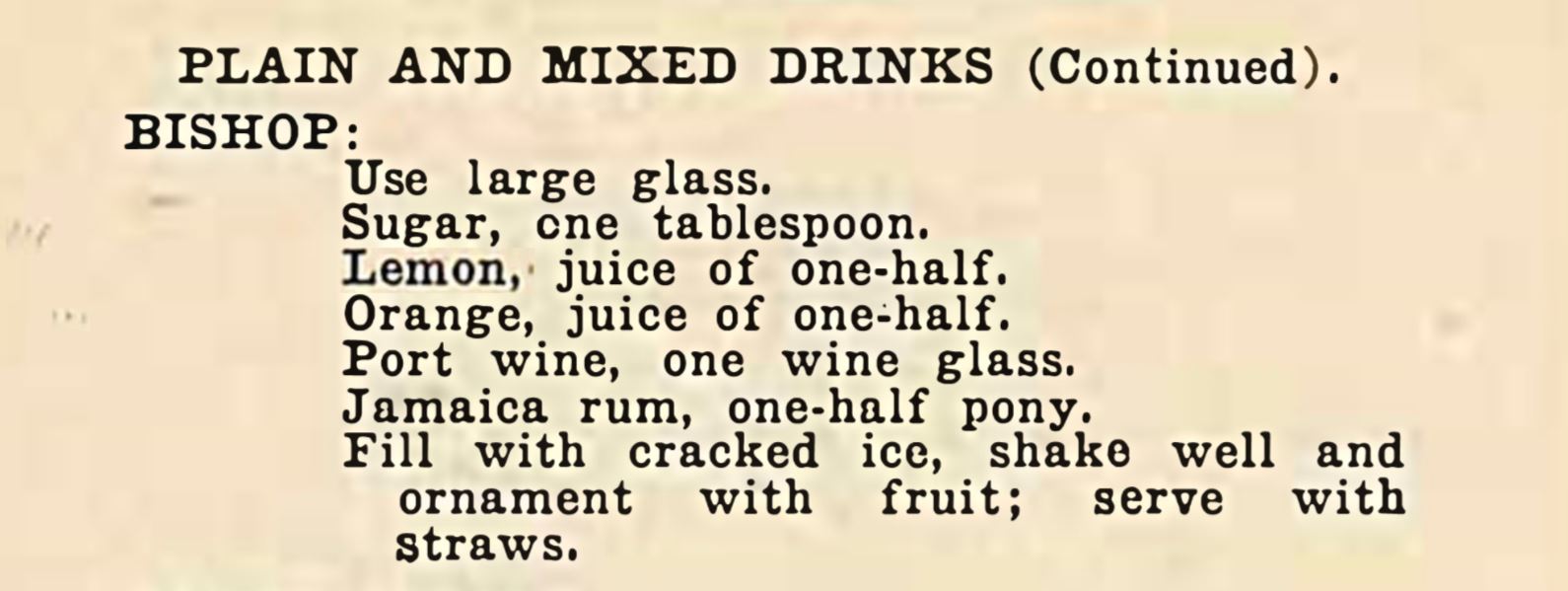 Bishop Cocktail from "How to Mix Drinks" (1906). Here's the original version, with my notes: Use large glass. Sugar, one tablespoons [try one teaspoon instead] Lemon, juice of one-half [or 1 tablespoon bottled] Orange, juice of one-half [or 2 tablespoons bottled] Port wine, one wine glass [ooops! I did a half, you can too] Jamaica rum, one-half pony [1/2 oz.] Fill with cracked ice, shake well and ornament with fruit [I used blood orange]; serve with straws. If you liked this post and would like to support more Food History Happy Hour livestreams, please consider becoming a member or joining us on Patreon. Members and patrons get special perks like access to members-only content.
Thanks to everyone who joined me last night for Food History Happy Hour live on Facebook. This week, inspired by spring, all the flowers in my lawn, and supporting the pollinators, we made the Butterflies Cocktail from the Stork Club Bar Book (1946) and talked about edible flowers! We also discussed back of the box recipes, my latest published book review, farmerettes, Elizabeth's excellent question - 5 Recipes New Cooks Should Master During Quarantine, which I outline, and a discussion of lard, modern pork production, and how to render your own animal fats. Butterflies Cocktail (1946)So when I took note of this cocktail many weeks ago, I completely missed that it was designed as a "cure for butterflies in the stomach!" It still tastes like Kool-aid. And Glenn, you and Carla were right! It IS from the Stork Club, but the digitizing website has a typo in the title and referred to it as the "Stock Club." Hence the confusion. 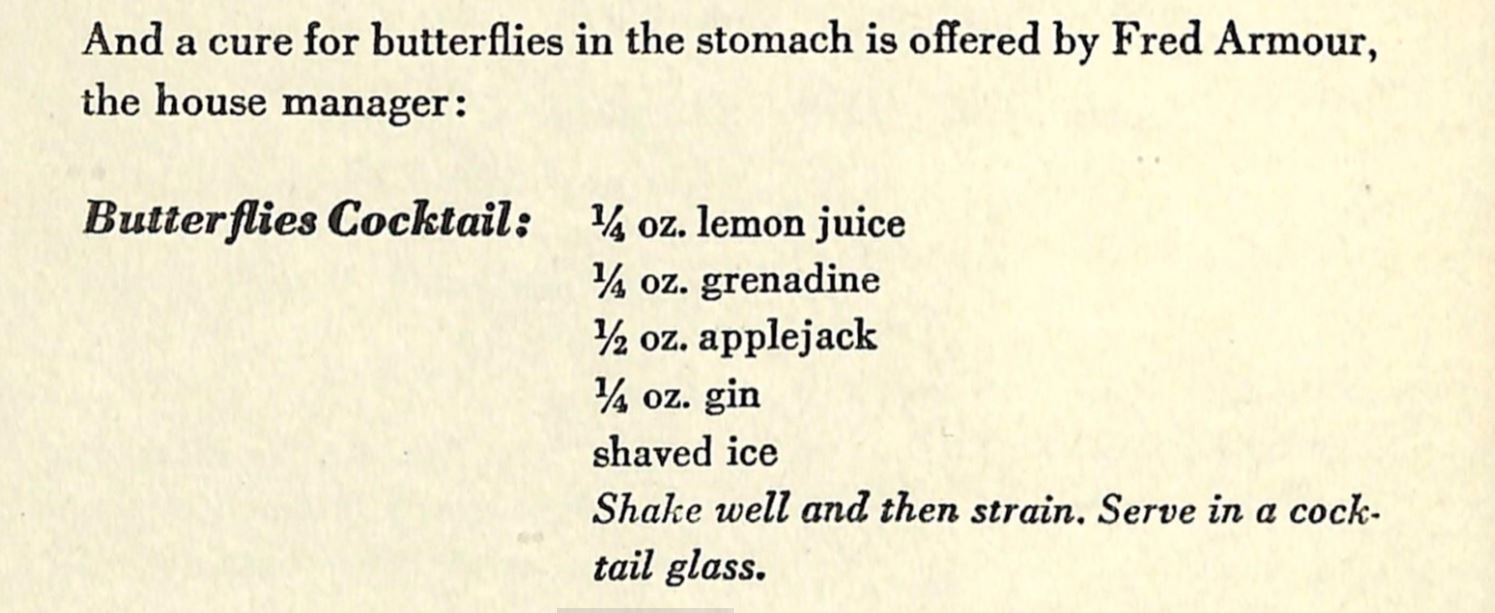 Butterflies Cocktail recipe from "The Stork Club Bar Book" by Lucius Beebe (1946). 1/4 ounce lemon juice 1/4 ounce grenadine 1/2 ounce applejack 1/4 ounce gin shaved ice Shake well and then strain. Serve in a cocktail glass. Water PieAnd! As a bonus for those who watched the whole video, here's where I first found out about the Great Depression's ingenious "water pie." If I find more, I will update! If you liked this post and would like to support more Food History Happy Hour livestreams, please consider becoming a member or joining us on Patreon. Members and patrons get special perks like access to members-only content.
|
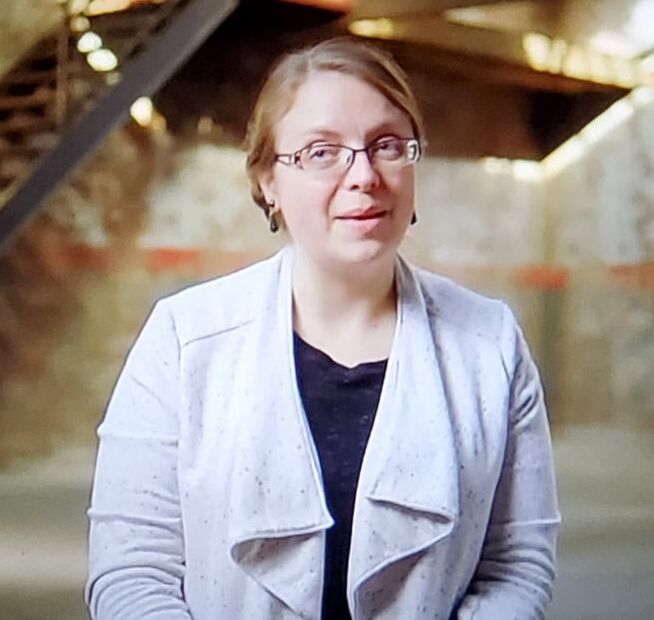
AuthorSarah Wassberg Johnson has an MA in Public History from the University at Albany and studies early 20th century food history. Archives
September 2023
Categories
All
|
 RSS Feed