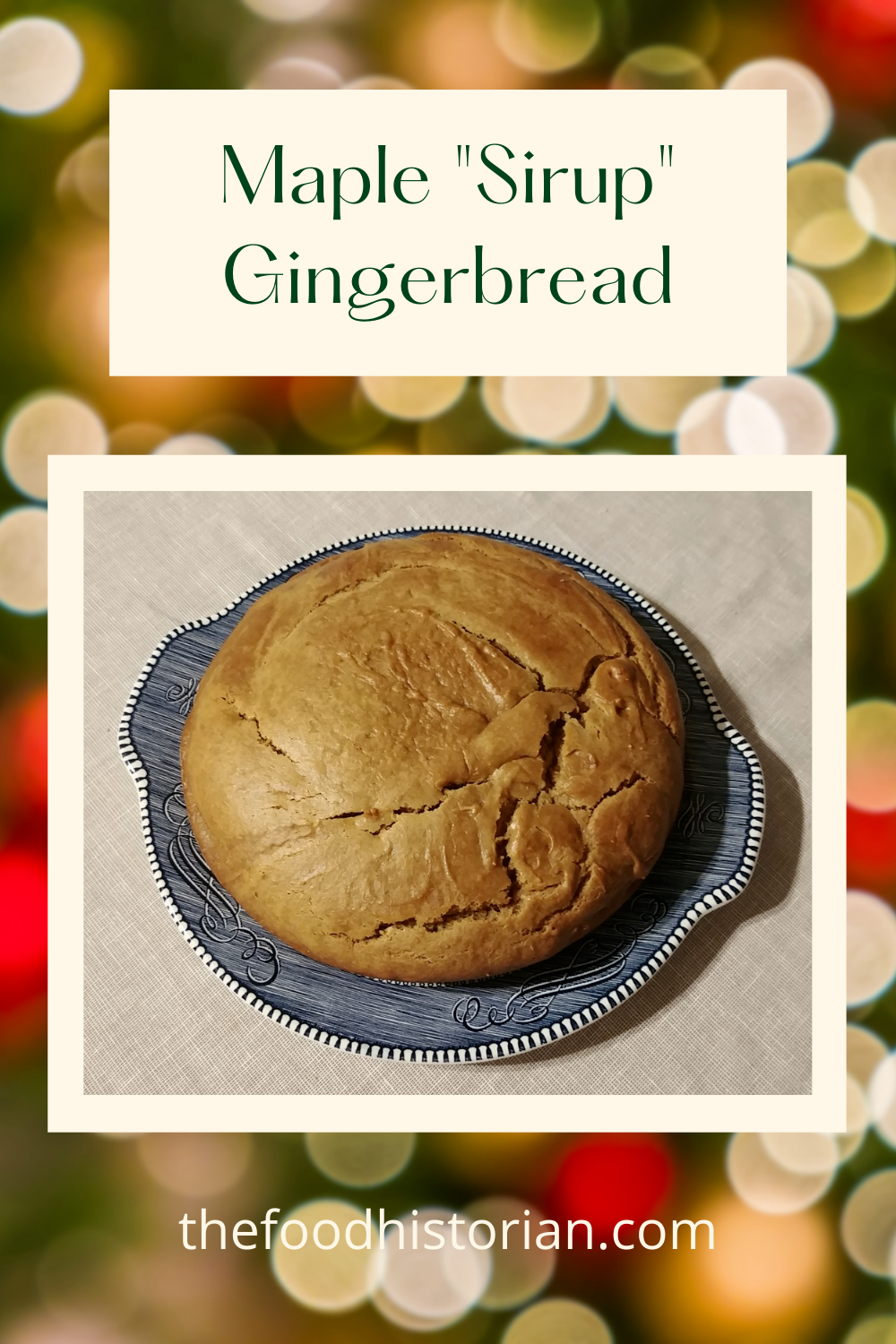
 I really debated what dessert would go best with White Christmas. Aside from the malted milkshake, and the General's birthday cake, none are mentioned in the movie. I thought about going the fruitcake route, but I didn't exactly have time for it to soak. And then, when flipping through The United States Regional Cook Book (1947), I ran across a recipe I'd found and wanted to try earlier in the year - "Maple Sirup Gingerbread." Gingerbread is a traditional Christmas food dating back to the Medieval period, and the use of maple syrup (or, in 1940s spelling, "sirup") made the recipe appropriately Vermont-y. During World War II, maple syrup was touted as a sugar alternative and throughout history it has generally been less expensive than refined white sugar. Not so today, when a quart of maple syrup ranges in price from $15-$25, depending on where you are (which means a cup averages about $5). If you'd rather not "waste" a whole cup of maple syrup on a cake, feel free to use a different gingerbread recipe (may I recommend New York Gingerbread?). 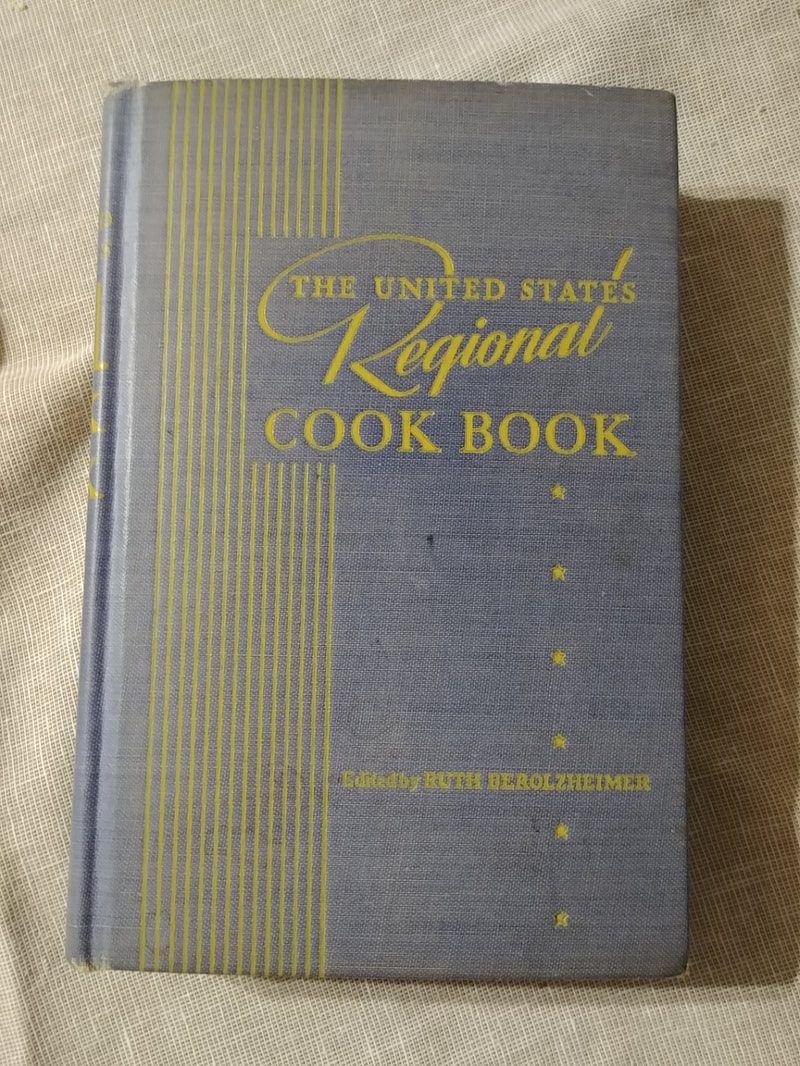 Cover of "The United States Regional Cook Book," (1947) edited by Ruth Berolzheimer. 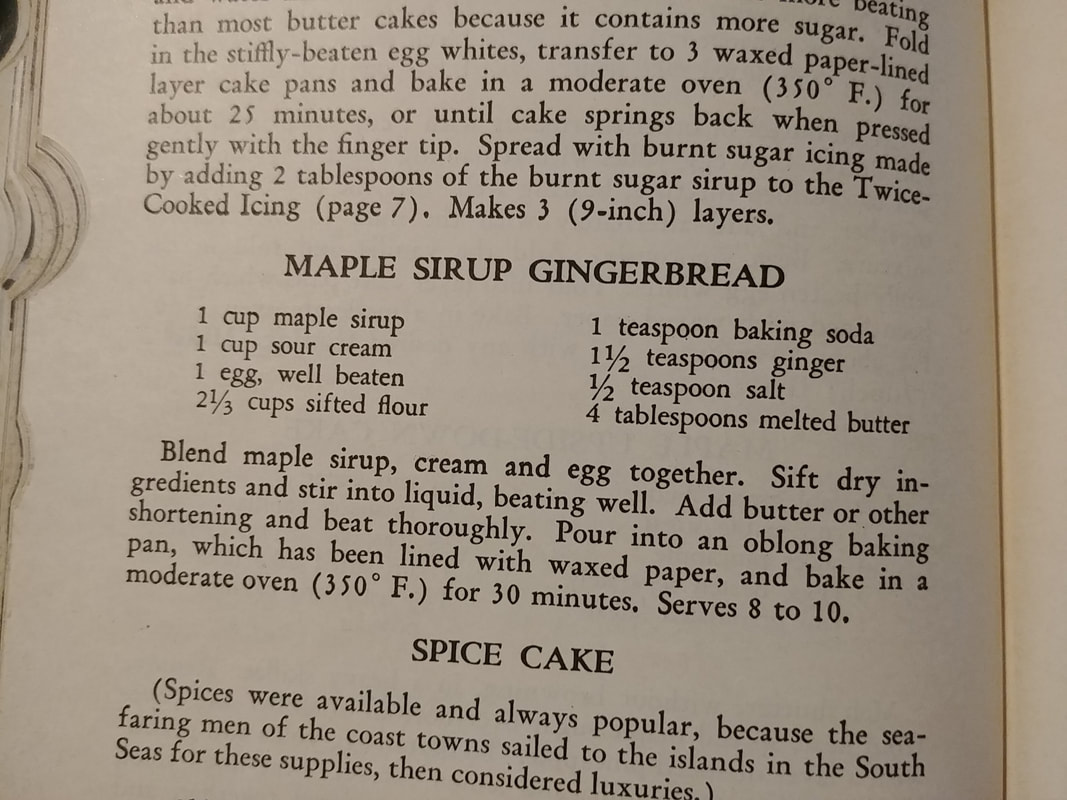 Original recipe for "Maple Sirup Gingerbread" from "The United States Regional Cook Book" (1947). Maple Sirup Gingerbread (1947)It occurred to me after I started making this that the "sour cream" in the recipe was probably SOURED liquid cream, instead of the thick, dairy sour cream we're used to these days. But I went with it anyway. If you want to try something closer to the original, split the difference and use a half cup of heavy cream and a half cup of sour cream. Aside from that, I made no changes to this recipe, except to make an executive decision about "oblong baking pans" and just do a round one instead. I also don't recommend lining the pan with waxed paper, unless you want the wax to melt into your cake and onto your pans. Parchment is fine, but unnecessary. Just grease the pan well. 1 cup maple syrup 1 cup sour cream 1 egg, well beaten (you don't actually have to beat the egg in advance) 2 1/3 cups sifted flour (ditto sifting) 1 teaspoon baking soda 1 1/2 teaspoons ginger 1/2 teaspoon salt 4 tablespoons melted butter (1/2 a stick) Blend maple syrup, sour cream, and egg together until smooth. Add dry ingredients and whisk into the liquid ingredients, making sure to stir well. Add butter and beat thoroughly. Pour into greased ROUND cake pan and bake at 350 F for 30-40 minutes, or until the center of the cake springs back to the touch. Loosen the edges and tip out the pan to cool on a rack. Serve warm or cold with plenty of whipped cream. 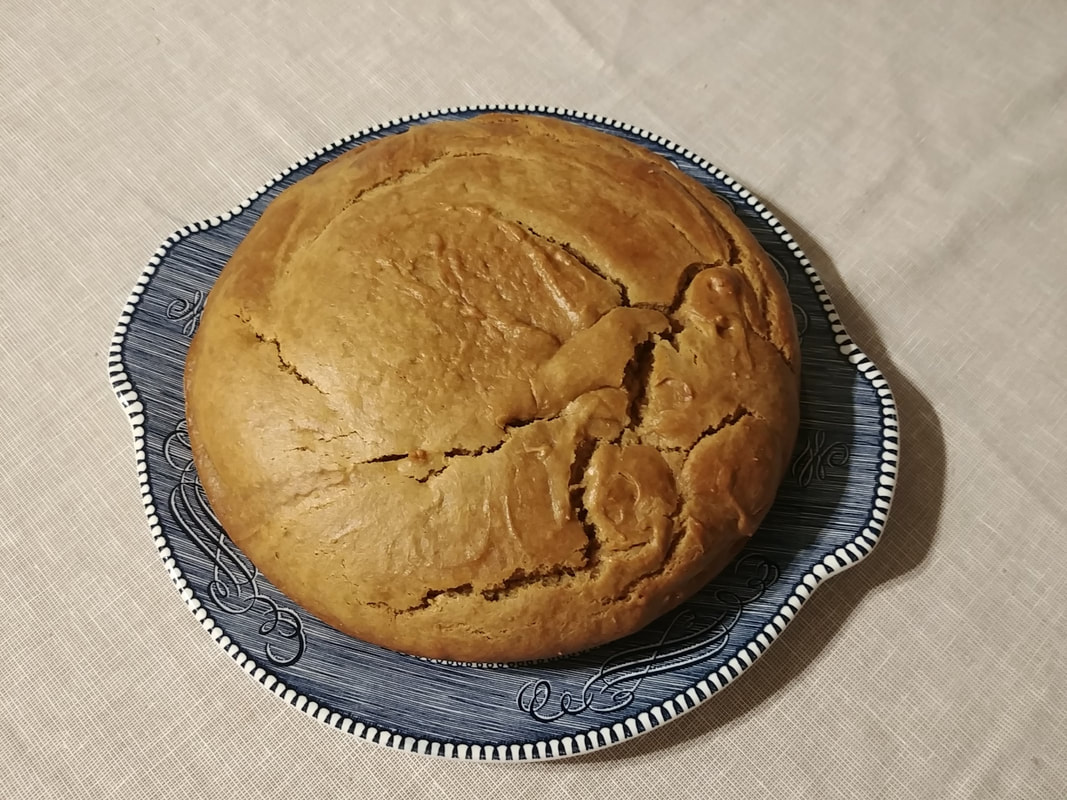 The finished Maple Sirup Gingerbread, with rustic-looking cracks, on my special 1950s Currier & Ives cake plate. 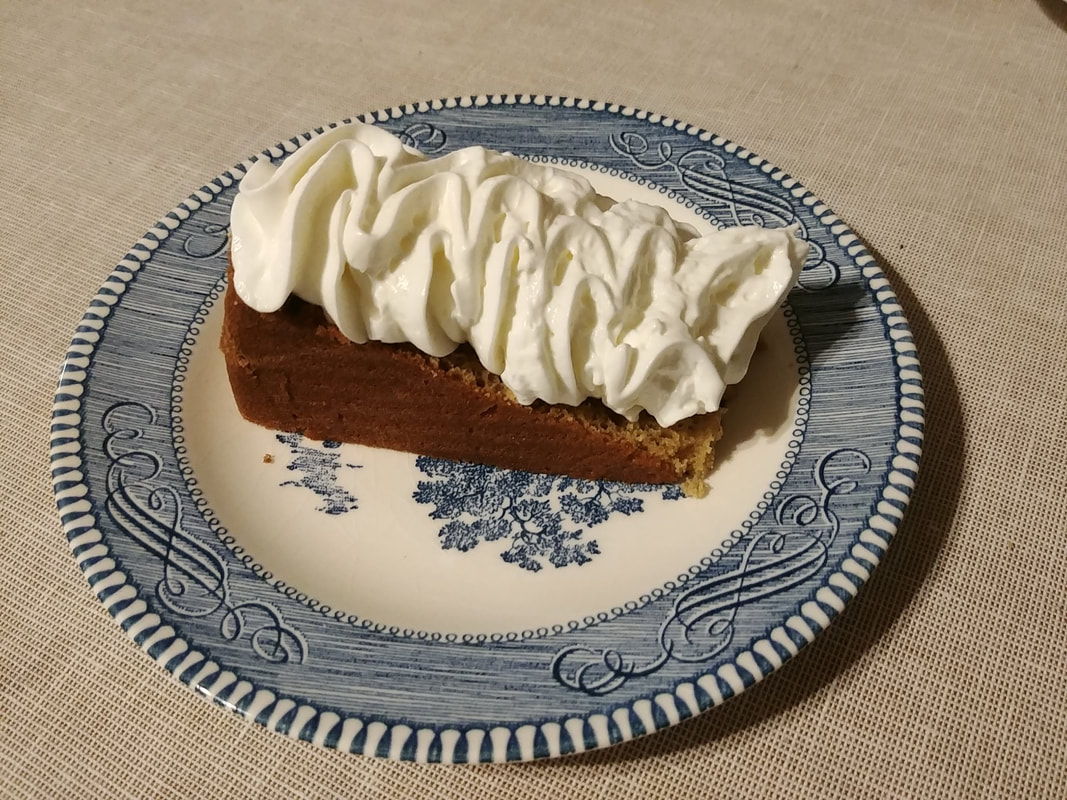 A thin slice of gingerbread with an appropriate amount of whipped cream. On a Currier & Ives bread/dessert plate. A word to the wise, you'll note that this recipe ONLY contains ginger, no other spices. But it contains quite a bit of ground ginger, which means the ginger flavor is very forward and in my opinion masks the flavor of the maple syrup, though my husband swore he could taste it. You might want to dial back the ginger a bit if you make it. Either way, it's very good - dense and moist with lots of good gingery flavor and feeling appropriately Christmassy. If you're trying to be healthier, I recommend subbing half of the all-purpose flour with a whole grain one. Spelt or rye would both be nice. So what do you think? Does Maple Sirup Gingerbread go with White Christmas (1954)? Let me know in the comments! And be sure to follow the White Christmas tag or visit the original menu post for the rest of the White Christmas Dinner and a Movie menu. Want to see more Dinner and a Movie posts? Make a request or drop your suggestions in the comments! The Food Historian blog is supported by patrons on Patreon! Join us for awesome members-only content like free digitized cookbooks from my personal collection, e-newsletter, and even snail mail from time to time!
0 Comments
 For those of you who have been following along, this is part of my "Dinner and a Movie: White Christmas" series! I wanted something to go nicely with the Vermont Parsnip Chowder, so I thought Vermont Graham Muffins would do very well, indeed. Graham flour is entire wheat flour (not to be confused with regular whole wheat flour, which is usually just white flour with some of the wheat germ added back in). Named after 19th century health reformer Sylvester Graham, it was one of the only parts of his largely unpalatable health and religious reforms, many of which were later adopted by Seventh Day Adventist prophet Ellen G. White and even later by John Harvey Kellogg, that was widely accepted by the general public. Graham pudding, graham gems, graham bread, graham muffins and eventually, yes, graham crackers (which would have appalled Sylvester), were all prevalent in cookbooks throughout the 19th and into the 20th century. And Kellogg used graham flour in his "Granula" cereal. Graham flour came to be widely associated with New England in the late 19th and early 20th centuries. This particular recipe I found in the absolutely delightful The United States Regional Cook Book, edited by Ruth Berolzheimer. My edition was published in 1947. It has a whole section on New England foods (among others), and "Vermont Graham Bread" is included in the chapter, "Breads, Quick Breads, and Pancakes." Cover of "The United States Regional Cook Book" (1947) edited by Ruth Berolzheimer. 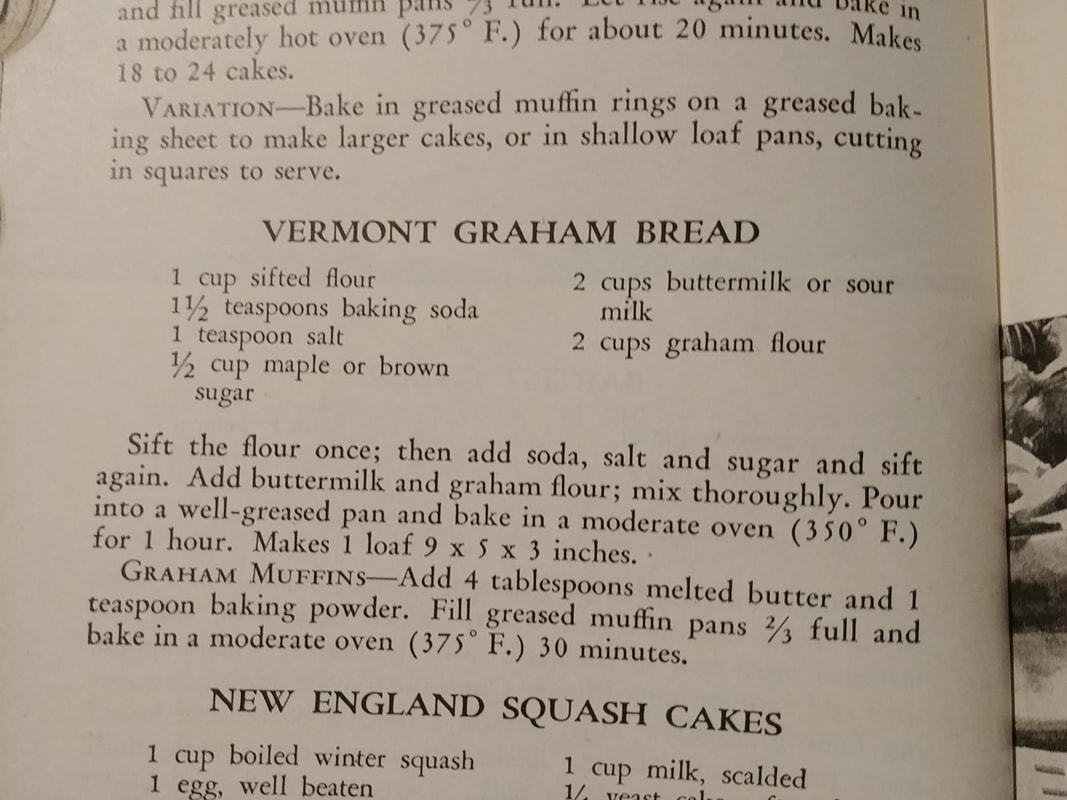 Original recipe for "Vermont Graham Bread" from "The United States Regional Cook Book" (1947). Vermont Graham (or Rye) MuffinsThe original recipe is geared towards a loaf of bread, but who wants to wait a whole hour for bread when you can have muffins in half the time? I should also confess that after all the rhetoric about Graham flour, I could not find any in the store, and I thought I had regular whole wheat flour at home. Wrong. So I substituted rye flour (an equally New England ingredient) and it was delightful. So feel free to substitute whole wheat, rye, or even spelt flour, if you like. I also made my own "buttermilk" with a tablespoon of lemon juice per cup of whole milk, but this recipe would probably be a smidge more moist with real buttermilk. This is my take on the original recipe, with the listed additions for muffins. 1 cup all-purpose flour 1 1/2 teaspoons baking soda 1 teaspoon baking powder 1 teaspoon salt 1/2 cup packed brown sugar (feel free to use less) 2 cups buttermilk 2 cups graham flour (or rye) 4 tablespoons butter, melted (half a stick) Preheat the oven to 375 F. Grease a standard muffin tin. Whisk together the all-purpose flour, graham flour, baking soda and powder, salt, and brown sugar until well combined (try not to leave any brown sugar lumps, but don't worry if you do). Stir in the buttermilk and melted butter. Spoon into muffin tins (makes a dozen) and bake 30 minutes, or until muffins are golden brown and spring back to the touch. Remove from tins and cool on a wire rack. Serve warm with plenty of butter. 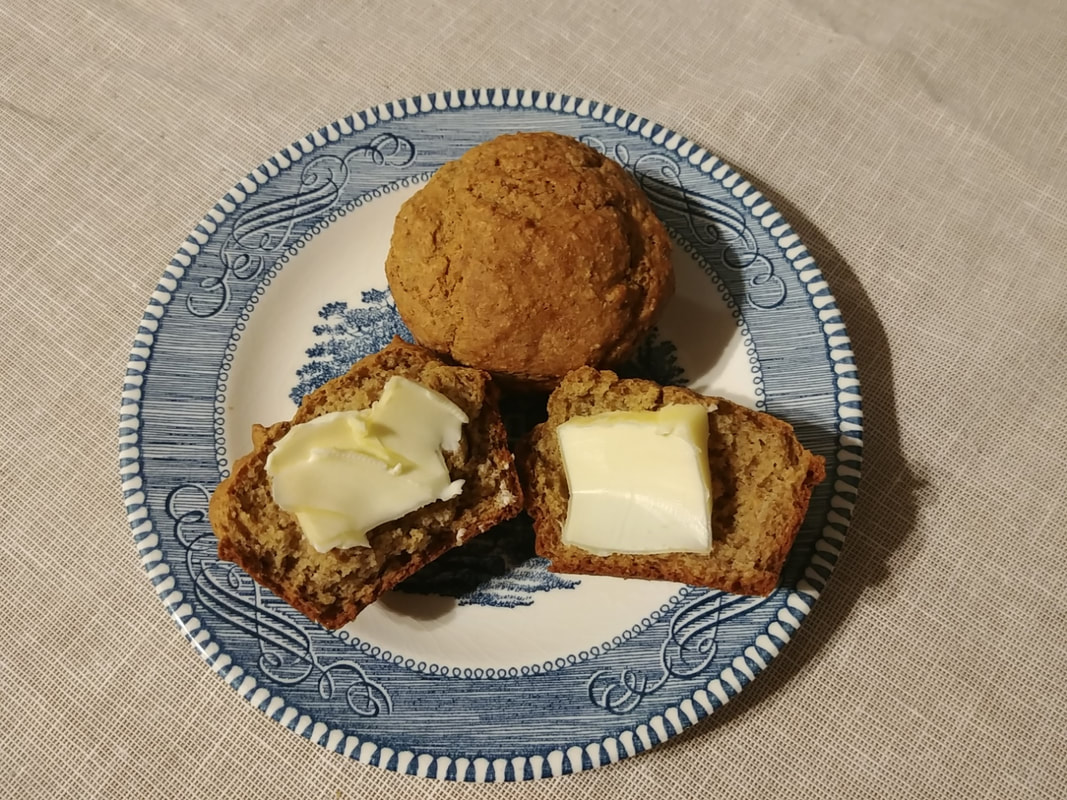 Vermont Graham Muffins, one split with butter, from "The United States Regional Cook Book" (1947). On my 1950s-appropriate Currier & Ives bread plate. These muffins taste slightly reminiscent of bran muffins, but are more like bread and less like the sugary sweet breakfast cakes most of us associate with the word "muffin." They are a bit sweet, so feel free to cut back on the brown sugar a bit if you're looking for something strictly more bread-like. They are best when served warm with butter, but are perfectly adequate cold as well. Do you think graham muffins go with White Christmas (1954)? Let me know in the comments! And be sure to follow the White Christmas tag or visit the original menu post for the rest of the White Christmas Dinner and a Movie menu. Want to see more Dinner and a Movie posts? Make a request or drop your suggestions in the comments! The Food Historian blog is supported by patrons on Patreon! Join us for awesome members-only content like free digitized cookbooks from my personal collection, e-newsletter, and even snail mail from time to time!  For those of you who have been following along, this is part of my "Dinner and a Movie: White Christmas" series! I wanted to find a vegetarian main dish to go with the movie, and given that Christmastime is cold up here in New York, I thought soup would be something cozy and not too elaborate. In perusing some of my vintage cookbooks, I ran across this gem in the 1977 New York Times New England Heritage Cookbook by Jean Hewitt. 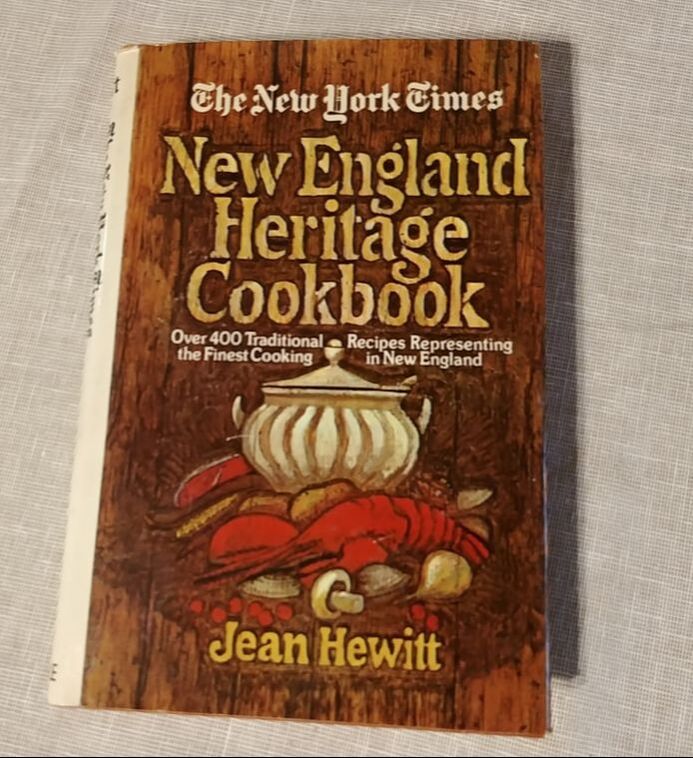 Clam chowder is, of course, quintessentially New England, which seemed appropriate given that our Fabulous Quartet were headed to Vermont for the winter holiday. And clam chowder is one of my husband's favorites, but I'm allergic to shellfish. This recipe for Parsnip Chowder is attributed to Vermont, which makes sense given that that great state does not border the ocean. And since parsnips are a delightful, if underutilized, vegetable, I thought I would give this chowder a go. Because our friend is vegetarian, I did end up making a few changes. 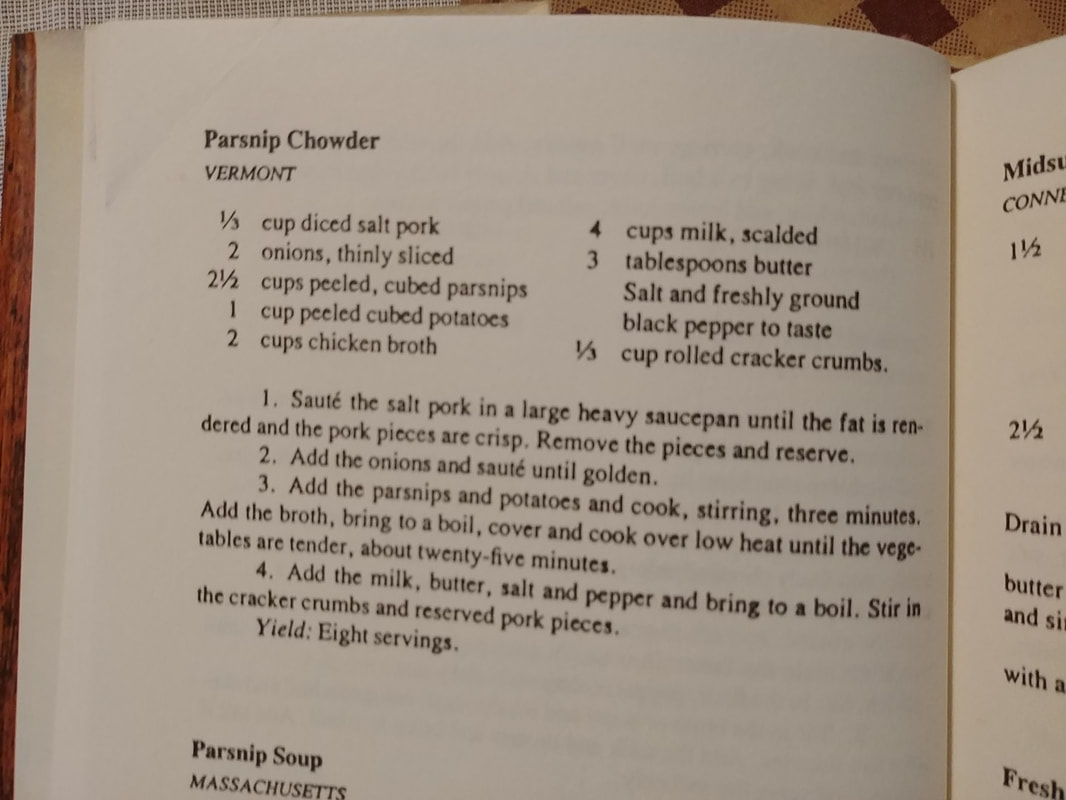 Vermont Parsnip Chowder (1977)Here's the original recipe (pictured above): 1/3 cup diced salt pork 2 onions, thinly sliced 2 1/2 cups peeled, cubed parsnips 1 cup peeled, cubed potatoes 2 cups chicken broth 4 cups milk, scalded 3 tablespoons butter salt and freshly ground black pepper to taste 1/3 cup rolled cracker crumbs 1. Sauté the salt pork in a large, heavy saucepan until the fat is rendered and the pork pieces are crisp. Remove the pieces and reserve. 2. Add the onions and sauté until golden. 3. Add the potatoes and parsnips and cook, stirring, three minutes. Add the broth, bring to a boil, cover, and cook over low heat until the vegetables are tender, about twenty-five minutes. 4. Add the milk, butter, and salt and pepper and bring to a boil. Stir in the cracker crumbs and reserved pork pieces. Yield: Eight servings. Okay, so, I did not make many changes, but I did make a few substantial ones, which I think turned out quite nicely. Here are my changes: 1/4 cup olive oil (or half a stick of butter) 1 tablespoon smoked paprika 2 onions, sliced 4 cups parsnips, peeled and cubed (about 3 large parsnips) 2 cups red potatoes, cubed (about 3 smallish ones, and I like the peel for texture) 3 cups water 1 cup heavy cream 3 cups whole milk garlic salt black pepper In a large pot over medium heat, bloom the paprika in the olive oil, then add the onions and sauté until tender. Add the parsnips and potatoes and stir to coat. Let cook until slightly browned in spots. Add the water and bring to a boil, then reduce heat and simmer, covered, until the vegetables are fork-tender. Add the heavy cream, milk, garlic salt, and pepper, and simmer, cover off, until the chowder thickens. Taste and add more salt if necessary. The parsnips and onions make it quite sweet. 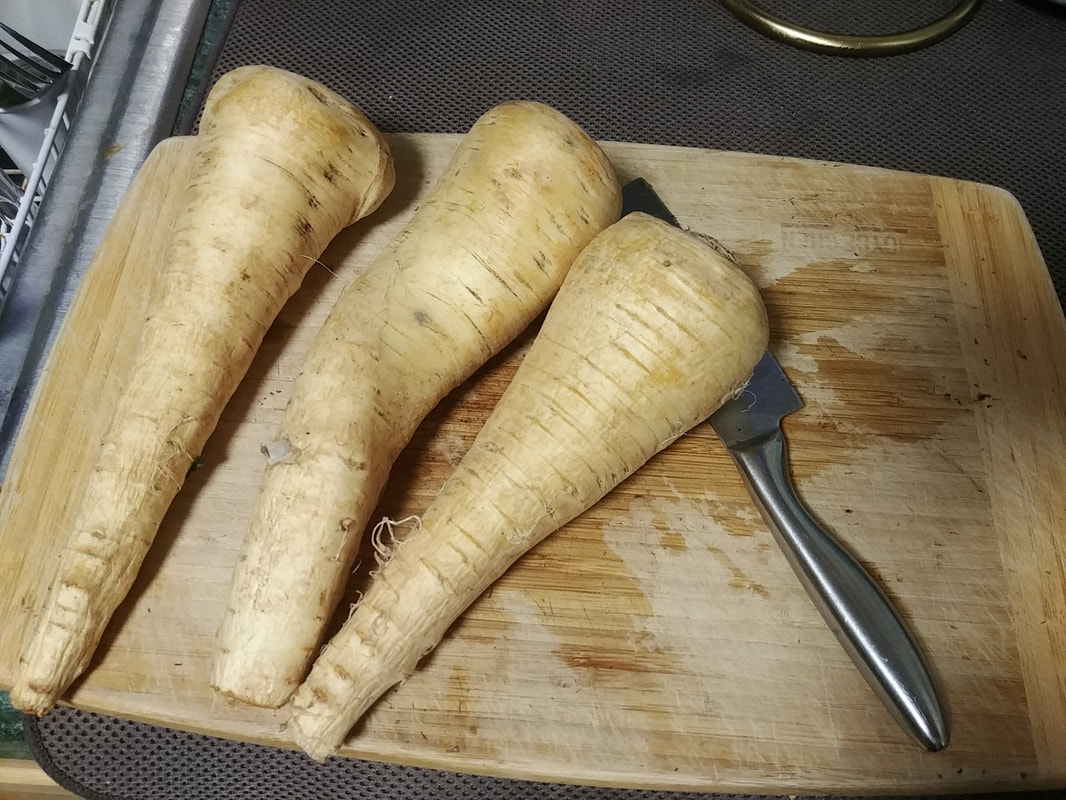 My suitably giant parsnips, unpeeled. I cut them into pieces about the size of playing dice. 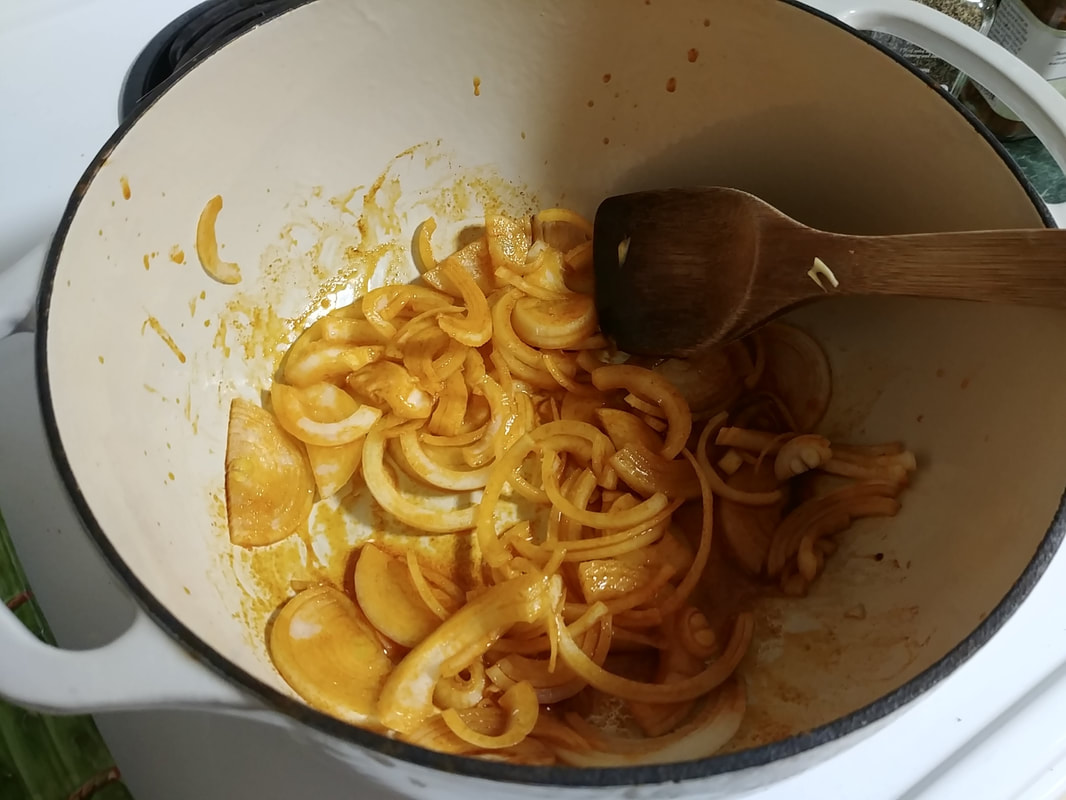 Beautifully ruddy onions, colored by the smoked paprika. The chowder turned out beautifully - a thick, creamy texture with tender bits of parsnip and potatoes (the onions basically melted into the cream) and a lovely golden color. The cream really thickens the chowder up without the addition of crackers (although you could add saltines or oyster crackers if you want). We ate up the leftovers pretty quickly, and in some ways it was better the next day. 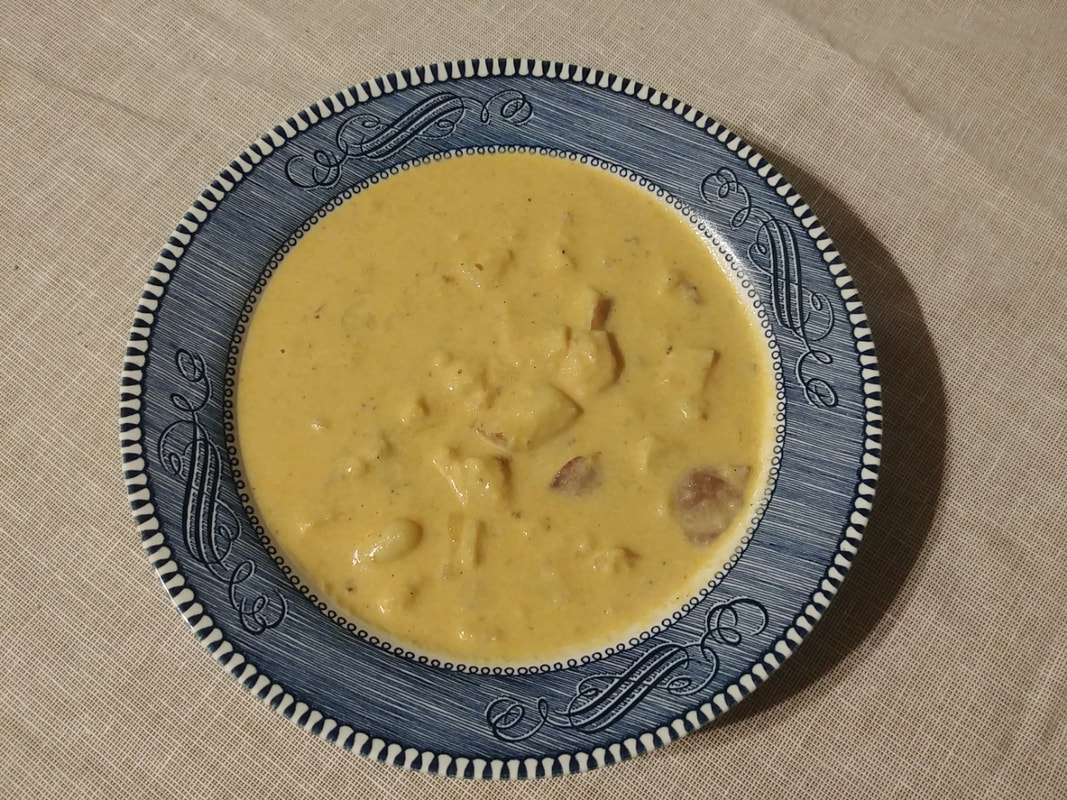 The beautifully golden parsnip chowder in my appropriately 1950s Currier & Ives soup bowl. What do you think? Is parsnip chowder something you would try? Do you think it goes with White Christmas (1954)? Let me know in the comments! And be sure to follow the White Christmas tag or visit the original menu post for the rest of the White Christmas Dinner and a Movie menu. Want to see more Dinner and a Movie posts? Make a request or drop your suggestions in the comments! The Food Historian blog is supported by patrons on Patreon! Join us for awesome members-only content like free digitized cookbooks from my personal collection, e-newsletter, and even snail mail from time to time! 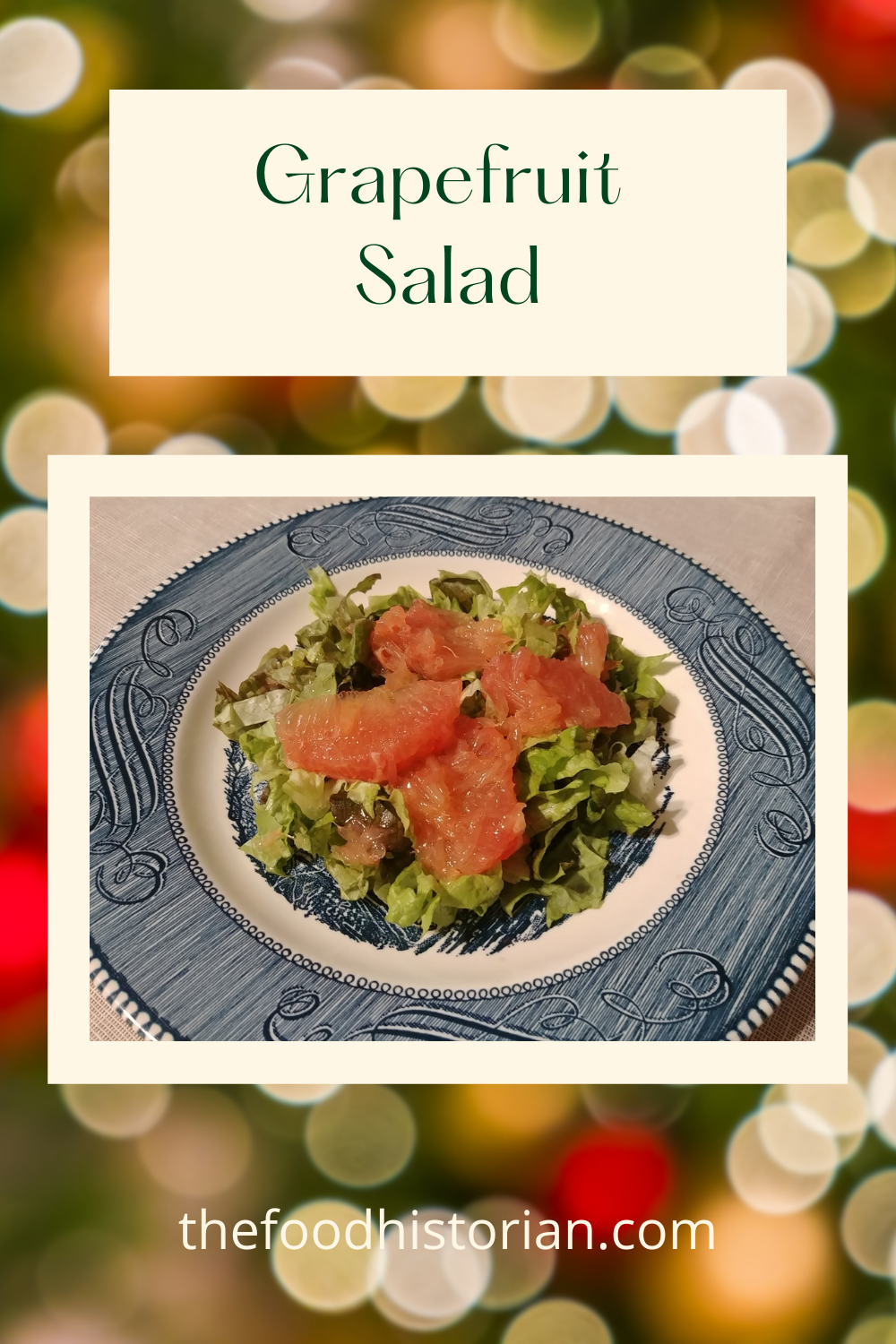 For those of you who have been following along, this is part of my "Dinner and a Movie: White Christmas" series! I chose this salad as a menu starter for a variety of reasons. One, because I enjoy grapefruit and wanted something relatively simple and refreshing to counter the heaviness of some of the other items on the menu. But also because grapefruit was a very typical appetizer and salad ingredient from the 1930s through the 1960s. Pink grapefruit was first commercialized in the late 1920s and by then grapefruit in general had become a popular breakfast food. In the 1930s, with the rise of Hollywood and the ubiquitousness of citrus fruits in both California and the newly popular Florida as a vacation spot, grapefruit took on other guises. Broiled grapefruit became a popular appetizer and it was increasingly used in salads. Commercially canned grapefruit became available in the mid-1920s, which added to its popularity. So, in a movie that doesn't QUITE make Hollywood and California the star, but which definitely "visits" the tropics through the tropical nightclub in Florida, grapefruit seemed like a natural addition to the menu. This particular one is quite a simple recipe, from my 1942 edition of the American Woman's Cook Book by Ruth Berolzheimer, an extremely popular cookbook that was in print from 1938 through the 1960s. 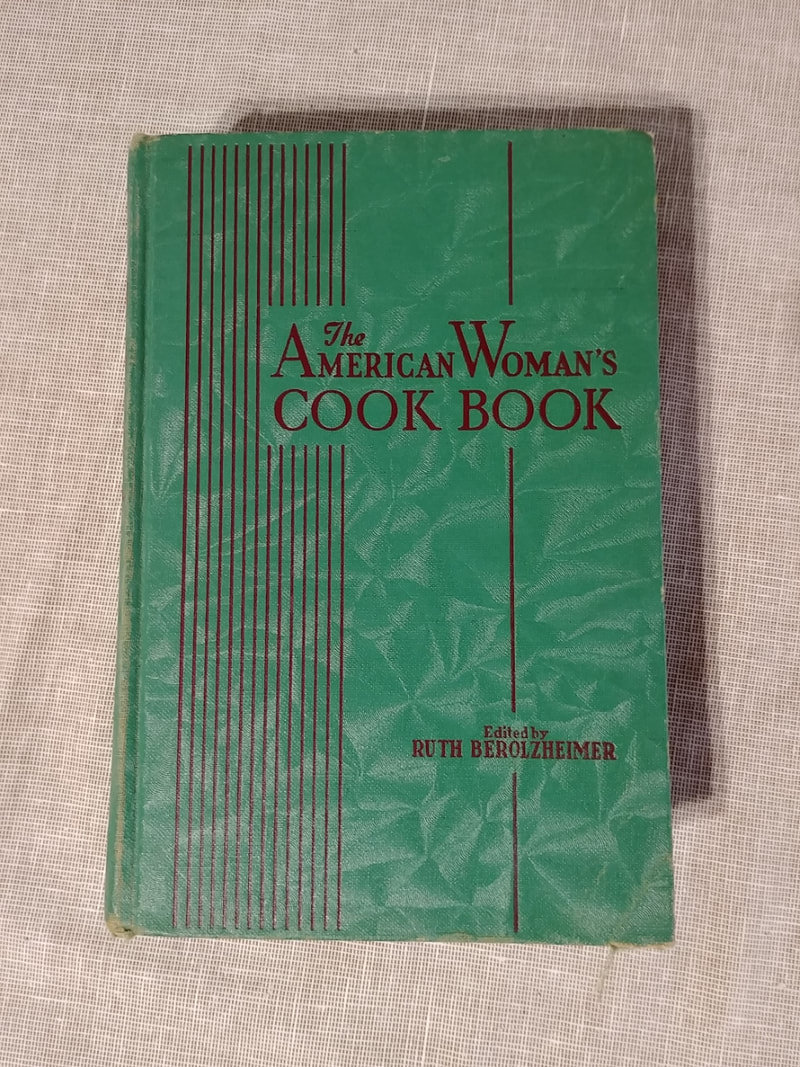 Cover of the "American Woman's Cook Book" (1942). 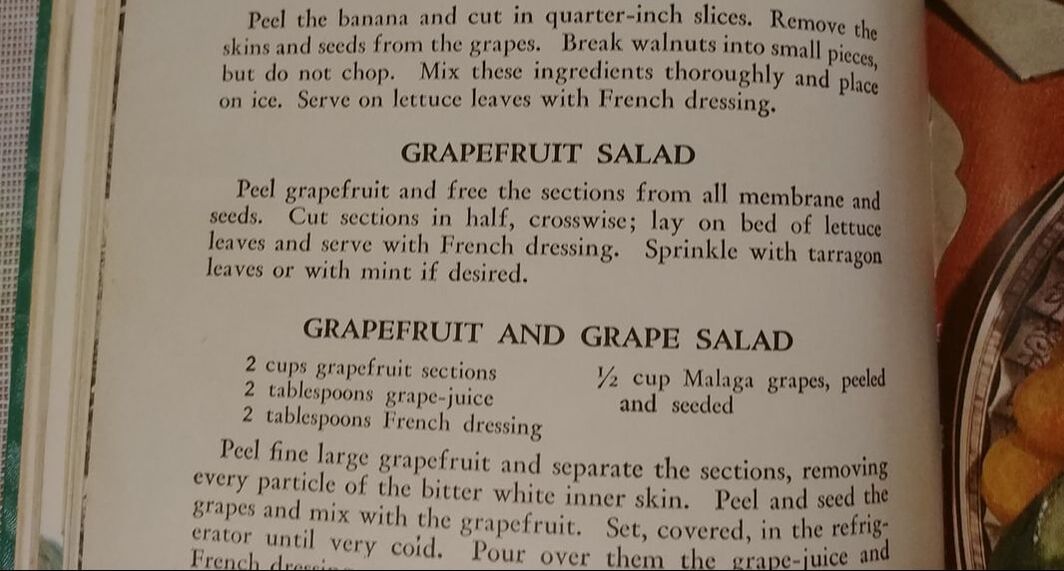 Grapefruit Salad (1942)The original recipe is quite simple. It reads: "Peel grapefruit and free the sections from all membrane and seeds. Cut sections in half, crosswise; lay on a bed of lettuce leaves and serve with French dressing. Sprinkle with tarragon leaves or with mint if desired." Supreming citrus (which is the official term for peeling and freeing citrus from the membrane) is extremely time-consuming work and doesn't always turn out how you'd like. Which is why if you'd rather use modern canned grapefruit, please feel free. The French dressing referred to in this recipe is NOT the modern, gloppy red stuff. It is, in fact, code for vinaigrette. I made my own, in my adaptation of the recipe, below. There's even a little maple syrup, to New England things up a bit. 1 large pink grapefruit for every two people 2 tablespoons olive oil 1 tablespoon maple syrup (optional) 1 tablespoon Dijon mustard thinly sliced red leaf lettuce Peel the grapefruit with a sharp knife over a small bowl to catch the juice. Using the knife, carefully cut each section away from the membrane on either side and cautiously remove, trying to keep the section intact. When done, squeeze the remaining pulp for juice into the bowl. Arrange the lettuce on each plate, then add the sections (you can cut them in half, or not). If you get 8 intact sections, you're doing better than I did. With a fork, mash up any remaining pulp into the juice (fish out any seeds), then add the olive oil, maple syrup, and Dijon mustard and whisk with the fork to combine. Pour the dressing over the sections and lettuce and serve. 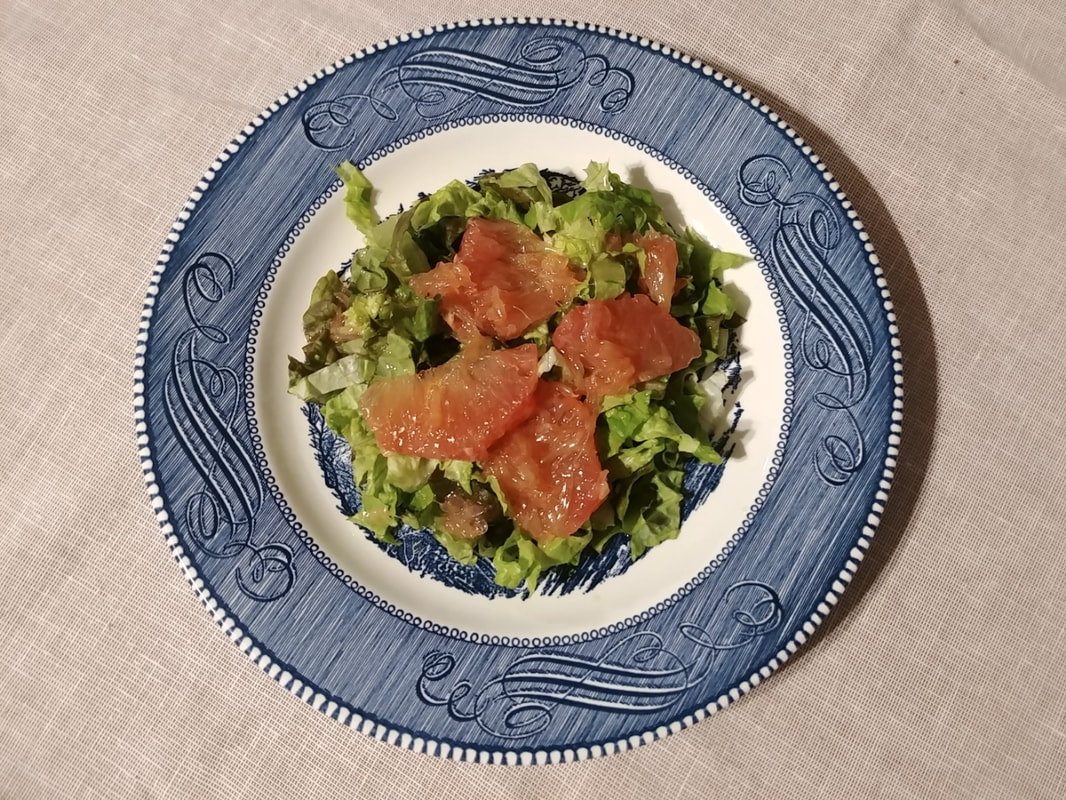 The pretty (and tasty) plated grapefruit salad. On my 1950s-appropriate Currier & Ives dinner plates. And that's it! Simple, if not easy (supreming is hard work!), and very tasty. The maple and the grapefruit flavors go very well together, although the dressing is a bit sweet. Do you think it goes with White Christmas (1954)? Let me know in the comments! And be sure to follow the White Christmas tag or visit the original menu post for the rest of the White Christmas Dinner and a Movie menu. Want to see more Dinner and a Movie posts? Make a request or drop your suggestions in the comments! The Food Historian blog is supported by patrons on Patreon! Join us for awesome members-only content like free digitized cookbooks from my personal collection, e-newsletter, and even snail mail from time to time! 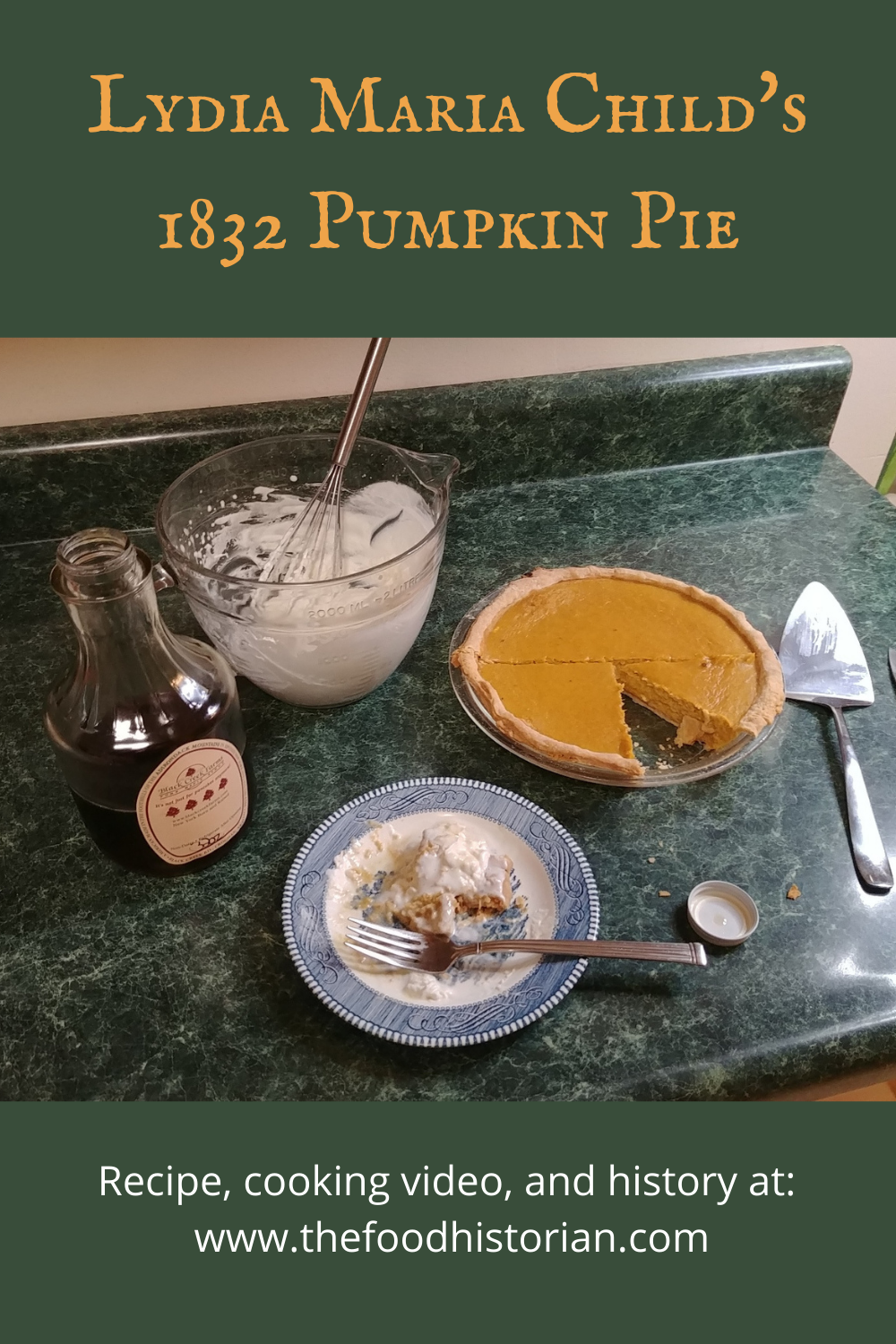 Last week I did the first of a series of several talks with cooking demonstrations for the Poughkeepsie Library. The first was all about pumpkin pie and I made Lydia Maria Child's original pumpkin pie recipe from her 1832 cookbook The American Frugal Housewife, and then followed it with a discussion of the history of pumpkin, pumpkin pie, and pumpkin pie spice. The library recorded the talk, so you can check it out below! Lydia Maria Child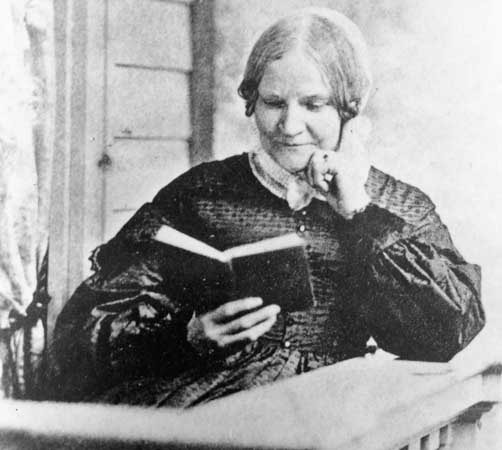 Photograph of Lydia Maria Child reading a book, c. 1865. Lydia Maria Child was born in Medford, Massachusetts in 1802. When she moved to Maine as a young woman to study to be a teacher, her older brother Convers, who had attended Harvard Seminary, assisted with her literary education. Upon reading and article about the rich resources New England history could provide novelists, she launched an unplanned writing career with her first novel, Hobomok, published in 1824. The book was set in 17th century New England and concerned the lives of a Native man, Hobomok, and the White woman he married and had a child with. Initially rejected by critics for its theme of miscegenation, it was later lauded by Boston literary circles. While teaching, Lydia Maria turned her attention to writing again, founding Juvenile Miscellany in 1826 - the first American monthly periodical designed specifically for children. Under Child's editorship, it became a popular and groundbreaking publication, emphasizing Protestant morality without the boring proselytizing common in children's literature at the time. In 1828 she married David Lee Child, a Boston lawyer and journalist (her maiden name was Francis) and stopped teaching, but not writing. In 1829 she published The Frugal Housewife: Dedicated to those who are not ashamed of economy, a cookbook directed at assisting the lower classes. It was published in several editions until 1832, when she changed the name to The American Frugal Housewife, to differentiate it from another cookbook of the same title published in Britain. Child published several other books on motherhood and household management, but her abolition work and radical politics largely derailed her literary career. She and her husband David Child began to identify as abolitionists in 1831. In 1833, she published An Appeal in Favor of that Class of Americans Called Africans, which called, among other things, for total abolition of slavery without compensation to enslavers. It was the first anti-slavery book (not pamphlet) published in the United States. Throughout the 1830s and '40s she became very active in the abolition and anti-slavery movements, publishing anti-slavery fiction, anti-slavery political tracts, and organizing fundraisers and events. Her anti-slavery stance and other radical politics enraged many readers in the American South, and subscriptions to Juvenile Miscellany declined so much that in 1834 she stepped down as editor. Sarah Josepha Hale edited the magazine until its closure in 1836. Child went on to publish tracts supporting Native American rights as well, including An Appeal for the Indians in 1868. Lydia Maria Child died in 1880 at the age of 78. Because of her political beliefs, she did not see the financial success of many of her author peers. But The American Frugal Housewife remains one of her most enduring legacies, along with her most famous poem, "A New England Boy's Song About Thanksgiving Day," which she published as part of her book Flowers for Children, Vol. 2 in 1844. You might know it better as "Over the River and Through the Woods." "A New England Boy's Song About Thanksgiving"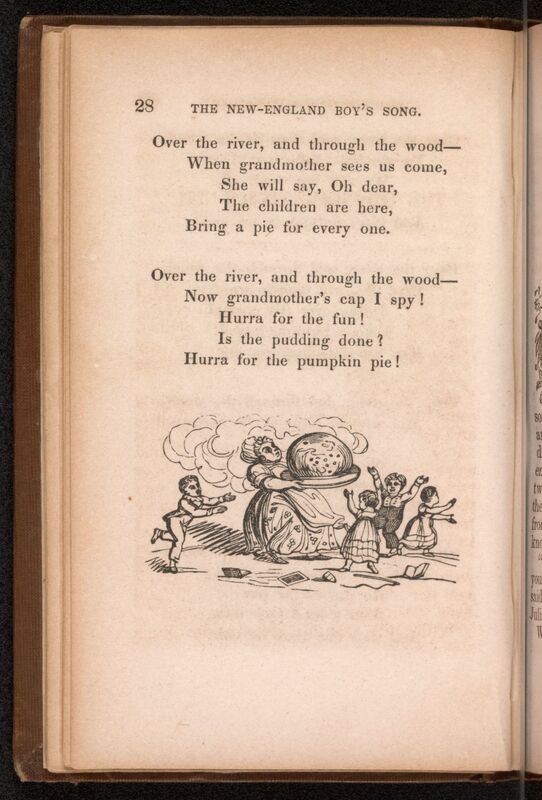 The final page from "The New England Boy's Song for Thanksgiving Day," featuring a delightful illustration of "grandmother" carrying not a pumpkin pie, but an enormous steamed pudding with hard sauce. "Flowers for Children, Volume II" (1844). Library of Congress. Over the river, and through the wood, To grandfather's house we go; The horse knows the way, To carry the sleigh, Through the white and drifted snow. Over the river, and through the wood, To grandfather's house away! We would not stop For doll or top, For 't is Thanksgiving day. Over the river, and through the wood, Oh, how the wind does blow! It stings the toes, And bites the nose, As over the ground we go. Over the river, and through the wood, With a clear blue winter sky, The dogs do bark, And children hark, As we go jingling by. Over the river, and through the wood, To have a first-rate play -- Hear the bells ring Ting a ling ding, Hurra for Thanksgiving day! Over the river, and through the wood -- No matter for winds that blow; Or if we get The sleigh upset, Into a bank of snow. Over the river, and through the wood, To see little John and Ann; We will kiss them all, And play snow-ball, And stay as long as we can. Over the river, and through the wood, Trot fast, my dapple grey! Spring over the ground, Like a hunting hound, For 't is Thanksgiving day! Over the river, and through the wood, And straight through the barn-yard gate; We seem to go Extremely slow, It is so hard to wait. Over the river, and through the wood, Old Jowler hears our bells; He shakes his pow, With a loud bow wow, And thus the news he tells. Over the river, and through the wood -- When grandmother sees us come, She will say, Oh dear, The children are here, Bring a pie for every one. Over the river, and through the wood -- Now grandmother's cap I spy! Hurra for the fun! Is the pudding done? Hurra for the pumpkin pie! "Pumpkin And Squash Pie" (the filling)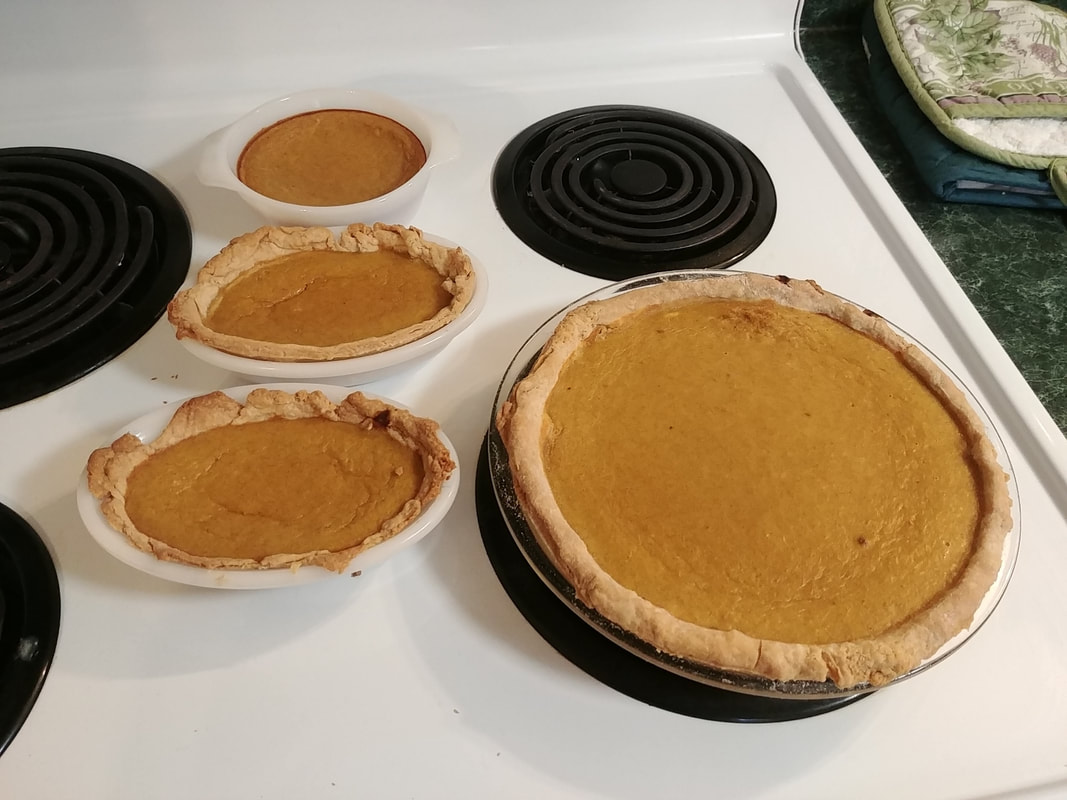 The finished pies I baked for the cooking demonstration! Here is Lydia Maria Child's original text: "For common family pumpkin pies, three eggs do very well to a quart of milk. Stew your pumpkin, and strain it through a sieve, or colander. Take out the seeds, and pare the pumpkin, or squash, before you stew it; but do not scrape the inside; the part nearest the seed is the sweetest part of the squash. Stir in the stewed pumpkin, till it is as thick as you can stir it round rapidly and easily. If you want to make your pie richer, make it thinner, and add another egg. One egg to a quart of milk makes very decent pies. Sweeten it to your taste, with molasses or sugar; some pumpkins require more sweetening than others. Two tea-spoonfuls of salt; two great spoonfuls of sifted cinnamon; one great spoonful of ginger. Ginger will answer very well alone for spice, if you use enough of it. The outside of a lemon grated is nice. The more eggs, the better the pie; some put an egg to a gill of milk. They should bake from forty to fifty minutes, and even ten minutes longer, if very deep." And here's my translation: 1 sugar pie pumpkin 2 cups whole milk 4 eggs 2 tablespoons cinnamon 1 tablespoon ground ginger 1/2 teaspoon salt 1/4-1/2 cup maple syrup Cut pumpkin in half, scoop out seeds, and roast, cut-side down, for 45 minutes at 350 F. When soft and easily pierced with a knife, remove from oven and scoop out flesh from rind. Mash thoroughly with a fork to remove stringiness. Let cool, then add spices and salt and mix thoroughly, then add all liquid ingredients. Pour into chilled pie shells (recipe below) and bake at 450 F for 15 minutes, then reduce heat to 350 F and bake for an additional 30 minutes. When the center is solid (a slight wobble is allowed), the pie is set and baked. Serve warm or cold with additional maple syrup (if desired) and whipped cream (recipe below). If you have extra filling, add to ungreased glass baking dishes or custard cups for equally good "crustless pumpkin pie." "Pie Crust"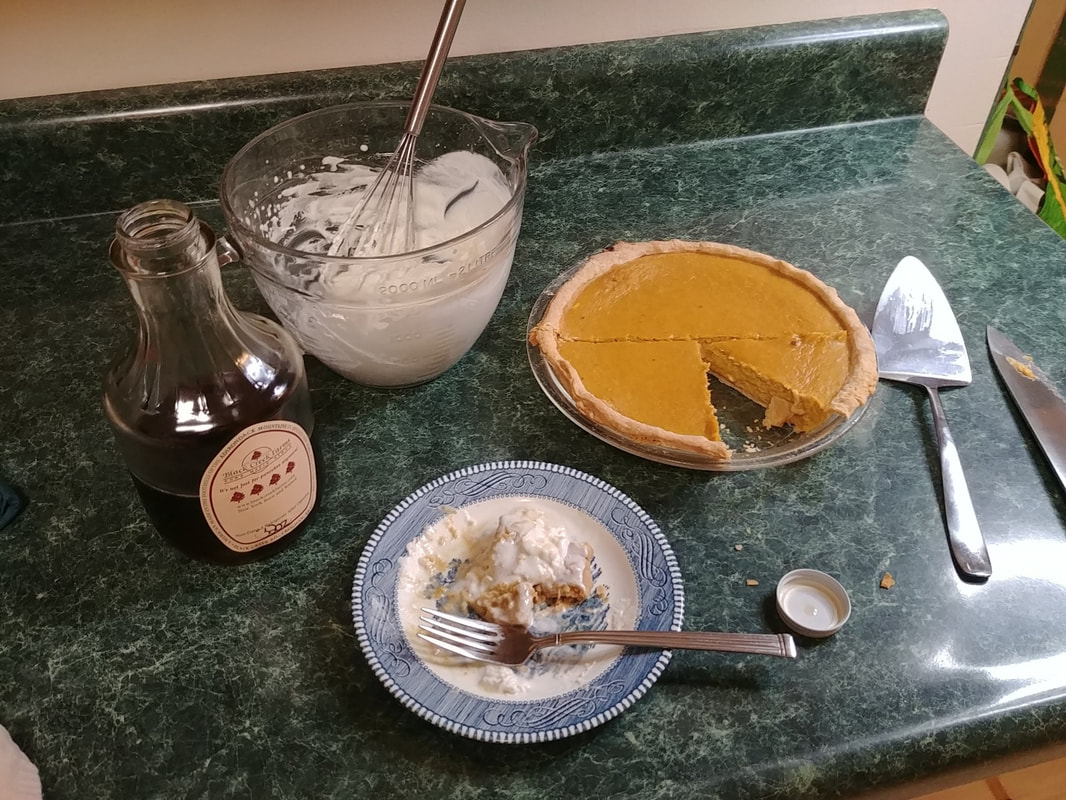 Half eaten pumpkin pie with extra maple syrup (I went very light on the maple syrup in the recipe) and hand-whipped cream. The original: "To make pie crust for common use, a quarter of a pound of butter is enough for half a pound of flour. Take out about a quarter part of the flour you intend to use, and lay it aside. Into the remainder of the flour rub butter thoroughly with your hands, until it is so short that a handful of it, clasped tight, will remain in a ball, without any tendency to fall to pieces. Then wet it with cold water, roll it out on a board, rob over the surface with flour, stick little lumps of butter all over it, sprinkle some flour over the butter, and roll the dough all up; flour the paste, and flour the rolling-pin; roll it lightly and quickly; flour it again; stick in bits of butter; do it up; flour the rolling-pin, and roll it quickly and lightly; and so on, till you have used up your butter. Always roll from you. Pie crust should be made as cold as possible, and set it in a cool place; but be careful that it does not freeze. Do not use more flour than you can help in sprinkling and rolling. The paste should not be rolled out more than three times; if rolled too much, it will not be flaky." Well that was a bit of a doozy of a recipe! Essentially, she's making an all-butter pie crust by combining shortbread and puff pastry techniques. And it turns out pretty well! If you're looking for a good all-butter pie crust recipe, this is a fairly reliable one, if you handle it gently. Here's my translation: 1 stick (1/4 pound) very cold unsalted butter 1 1/4 cup all-purpose flour 1/4-1/2 cup reserved flour for rolling ice water With cold hands, cut the stick of butter lengthwise in thirds, then rotate one quart of the way and cut in thirds again. Then cut crosswise until you have nice little cubes. Use at least half of the butter to rub into the 1 1/4 cup flour in a large bowl. Add more butter if you need to. From a bowl of ice water, using a tablespoon, add the water, 1-2 tablespoons at a time, and toss mixture with a fork. You'll need 6-8 tablespoons, depending on your flour and butter ratios. When you can make a ball with your hands and it sticks together nicely, but not too wet, you're good. Form the mass into a ball and roll out on a well floured surface, taking care to roll gently so as not to break the dough or roll unevenly. Once you have rolled out a round, spread whole cubes of butter across half the circle, fold in half, and roll that flat. Then repeat 2 more times (making sure to reserve enough butter for each rolling). When complete, roll out for crust. You'll have at least one single crust, with some left over for smaller pies. Place in pans, trim and crimp edges, and chill until ready to fill. Bake with pumpkin filling as directed above, or add your favorite fruit filling. My crust turned out delightfully crisp, but a little flat in flavor. A pinch of sugar and/or salt would probably be a nice addition. Hand Whipped Cream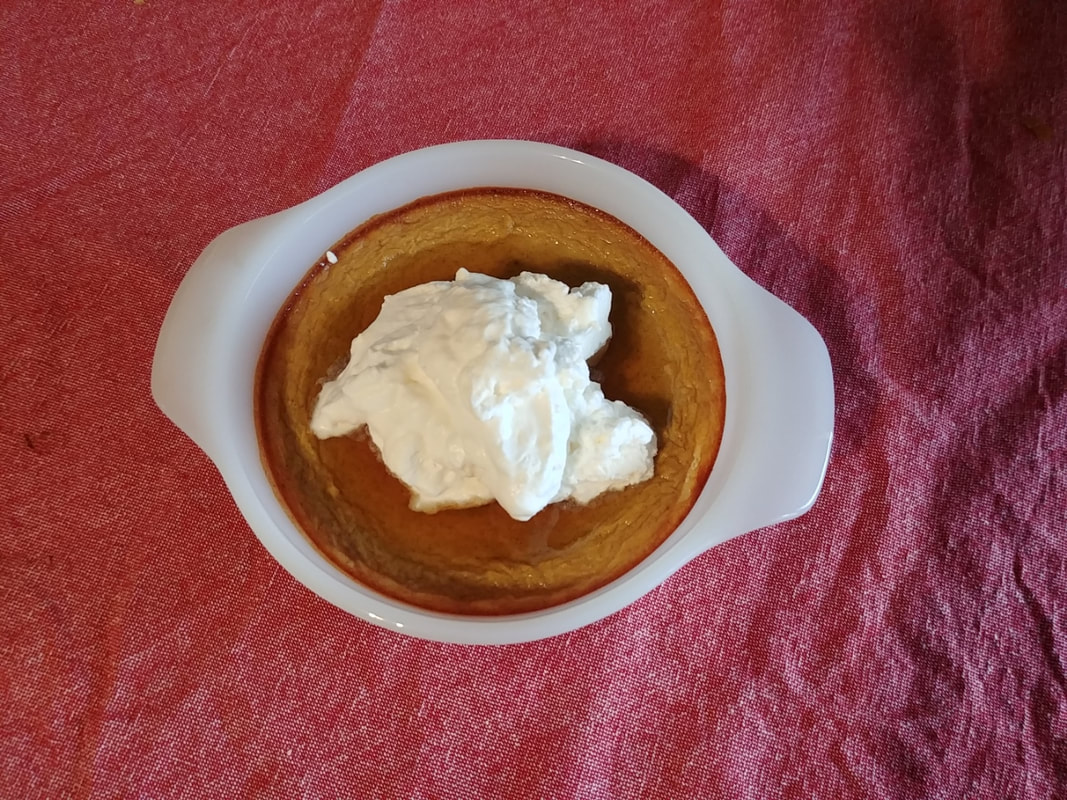 Morning breakfast of champions - crustless pumpkin pie with leftover whipped cream (refrigerated overnight and kept its volume!). This one isn't in The American Frugal Housewife, but it goes deliciously with pumpkin pie! The higher quality/fat content your cream, the easier it is to whip by hand. 1/2 cup heavy cream 1 tablespoon sugar or maple syrup 1 teaspoon homemade vanilla (recipe below) In a very deep bowl (preferably glass, which stays nice and cold), add the chilled cream, sugar, and vanilla. Tilt bowl and beat cream with a wire balloon whisk in a circular motion until you add enough air to the cream that it holds its shape. Do not overbeat, or you'll end up with sweet vanilla butter. Chill until ready to serve. Homemade VanillaHomemade vanilla lasts nearly forever, so it's a worthy investment, but vanilla beans are quite expensive these days, so make at your own expense. Still probably cheaper than buying the tiny bottles of the real stuff. You can make it with vodka, but I find the gold rum is much nicer and mellower. Also makes a great Christmas present. A dozen or so whole vanilla beans Gold rum (get the not-quite-the-cheapest brand) Cut the vanilla beans in half and add them to a quart jar. Fill jar with gold rum. Let sit in a dark place for a week or so before using. Keep adding rum as you deplete the vanilla. You want to keep the beans submerged at all times. Add beans every few years to keep the flavor up. Happy Thanksgiving!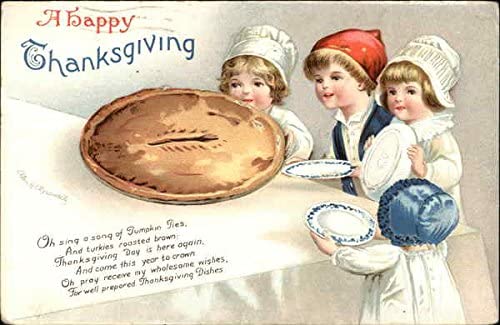 And that, my dears, is that. If you made it this far through the blog post, congratulations! I hope you enjoyed the video, some history about Lydia Maria Child, her famous poem, and the recipes. Keep your eyes peeled for more cooking-demonstration-and-talk programs coming up in December, January, and February. I hope you have a wonderful Thanksgiving! As always, The Food Historian blog is supported by patrons on Patreon! Join us for awesome members-only content like free digitized cookbooks from my personal collection, e-newsletter, and even snail mail from time to time! 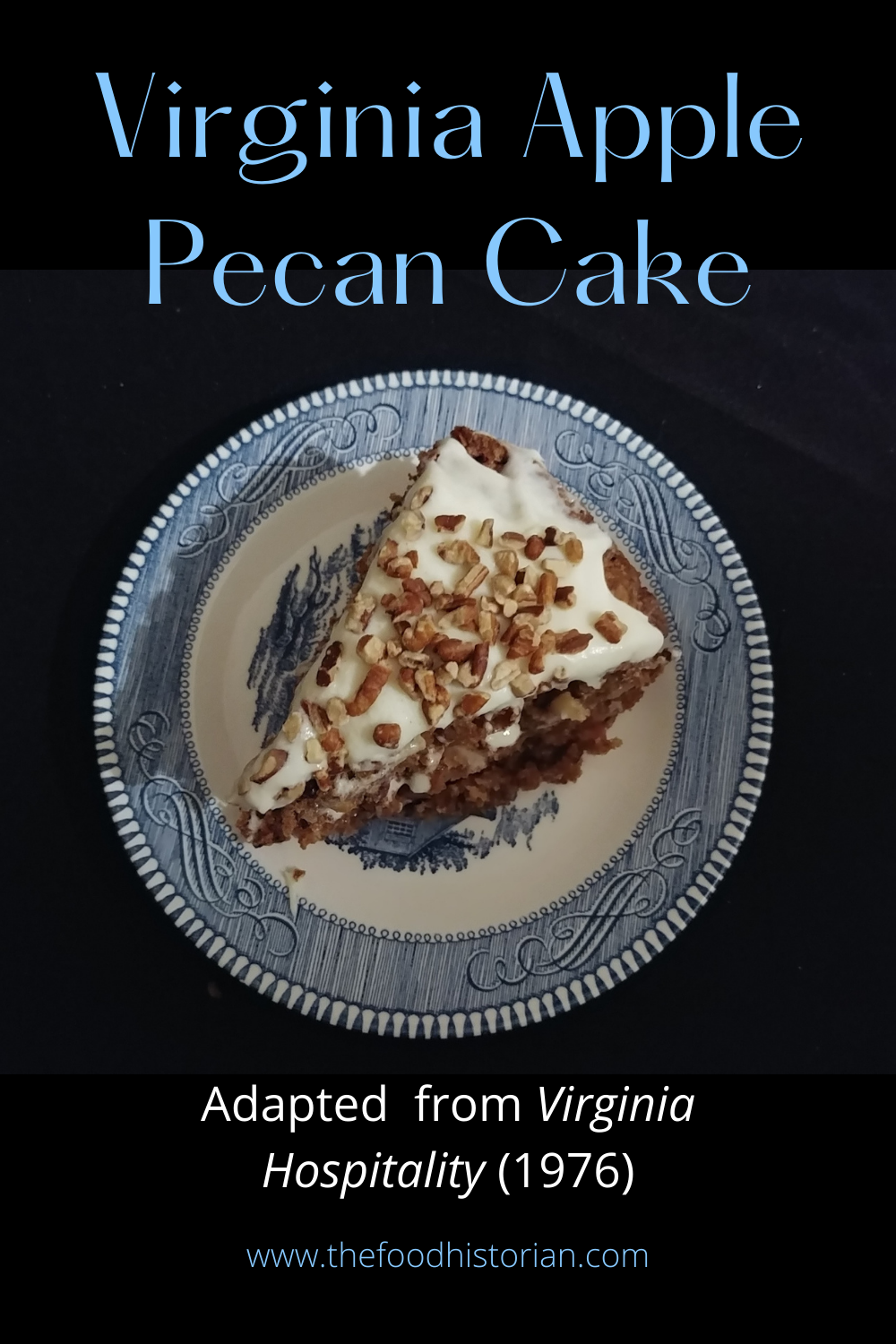 Here we are, five days later, and we finally have an election result. I made this cake on election day because I didn't have yeast for "real" election cake (more on that below), I had a bunch of homegrown Liberty apples to use up, and felt like making a layer cake with my new cake pans (somehow I lost one of my old pair of cake pans?). I had made this Virginian Apple Cake before, but it didn't turn out too great. So I tried again and did some tweaking and this time it turned out WONDERFULLY. It's now officially Virginia Apple Pecan Cake, in my book. Virginia Apple Pecan Cake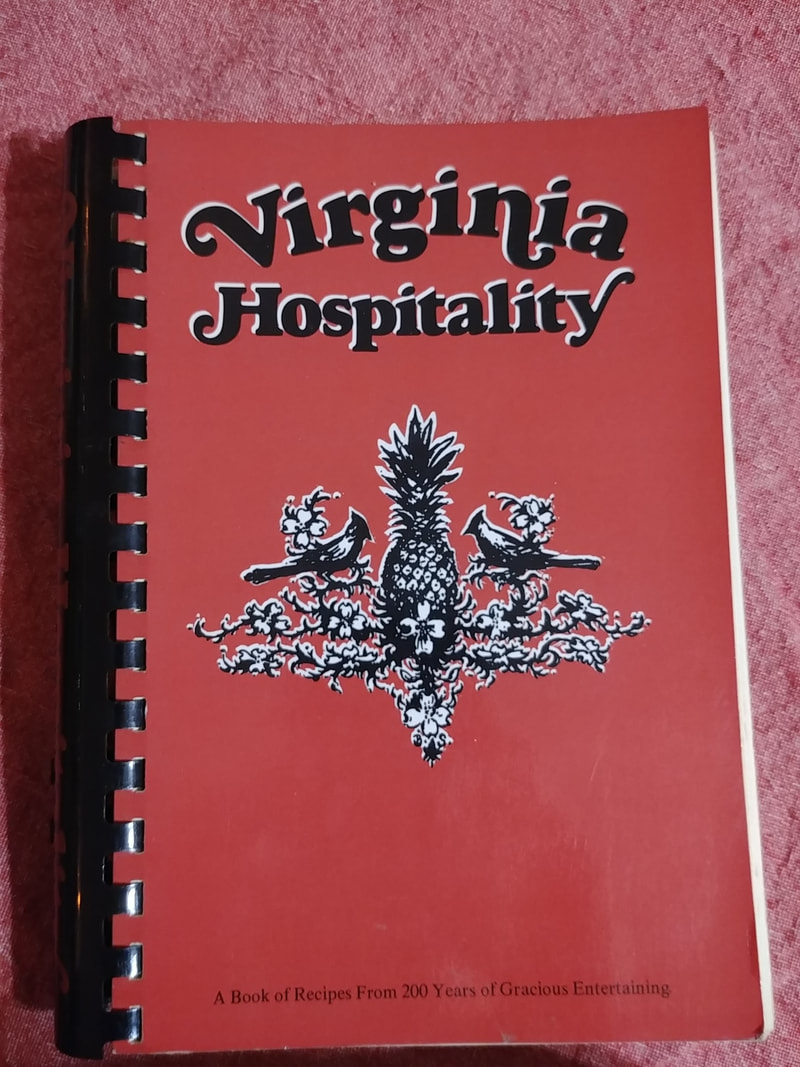 This recipe is from the community cookbook, Virginia Hospitality, first published in 1976 for the Bicentennial, but my copy is the ninth printing, from 1984. It's a fascinating little recipe - the only liquid comes from the eggs and softened butter and the apples themselves. The batter is VERY thick, but bakes up beautifully - a light and somewhat fragile texture - essentially just apples and nuts held loosely together by a light spiced batter. Here's the original recipe: 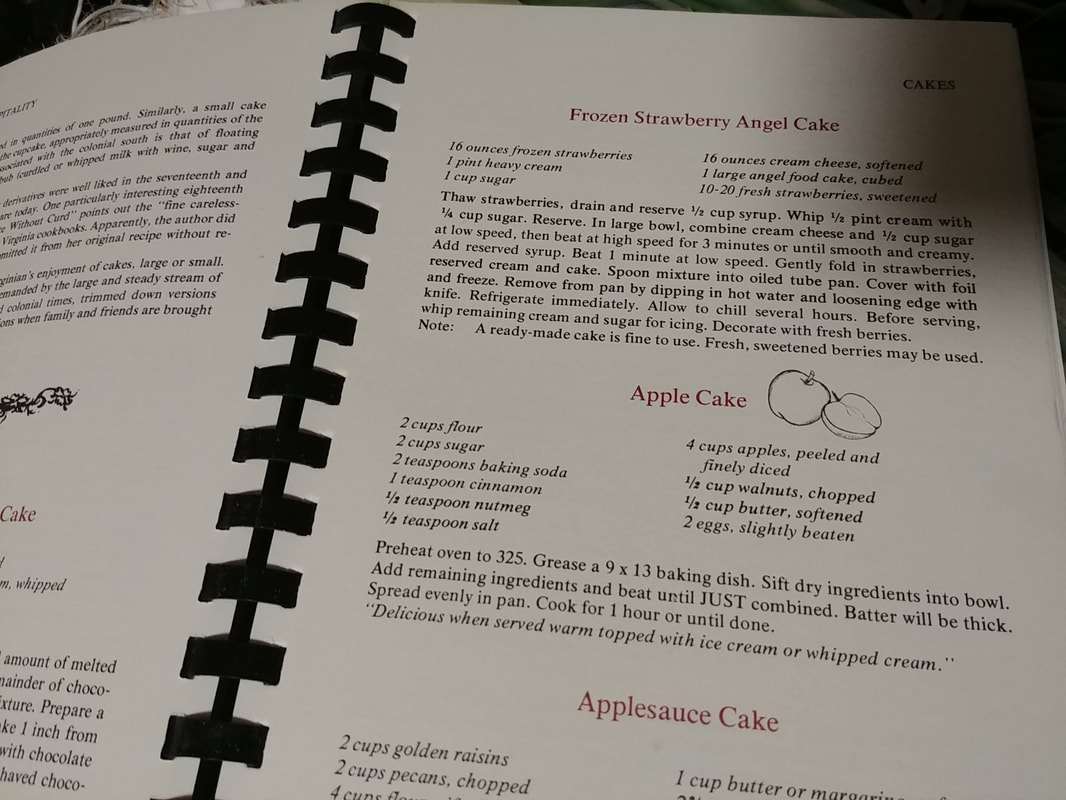 The original recipe reads: 2 cups flour 2 cups sugar 2 teaspoons baking soda 1 teaspoon cinnamon 1/2 teaspoon nutmeg 1/2 teaspoon salt 4 cups apples, peeled & finely diced 1/2 cup walnuts, chopped 1/2 cup butter, softened 2 eggs, slightly beaten Preheat oven to 325. Grease a 9 x 13 baking pan. Sift dry ingredients into a bowl. Add remaining ingredients and beat until JUST combined. Batter will be thick. Spread evenly in pan. Cook for 1 hour or until done. "Delicious when served warm topped with ice cream or whipped cream." It certainly is perfectly lovely as a plain sheet cake, but I wanted something a little different, so I made some changes not only to the style but the recipe itself. 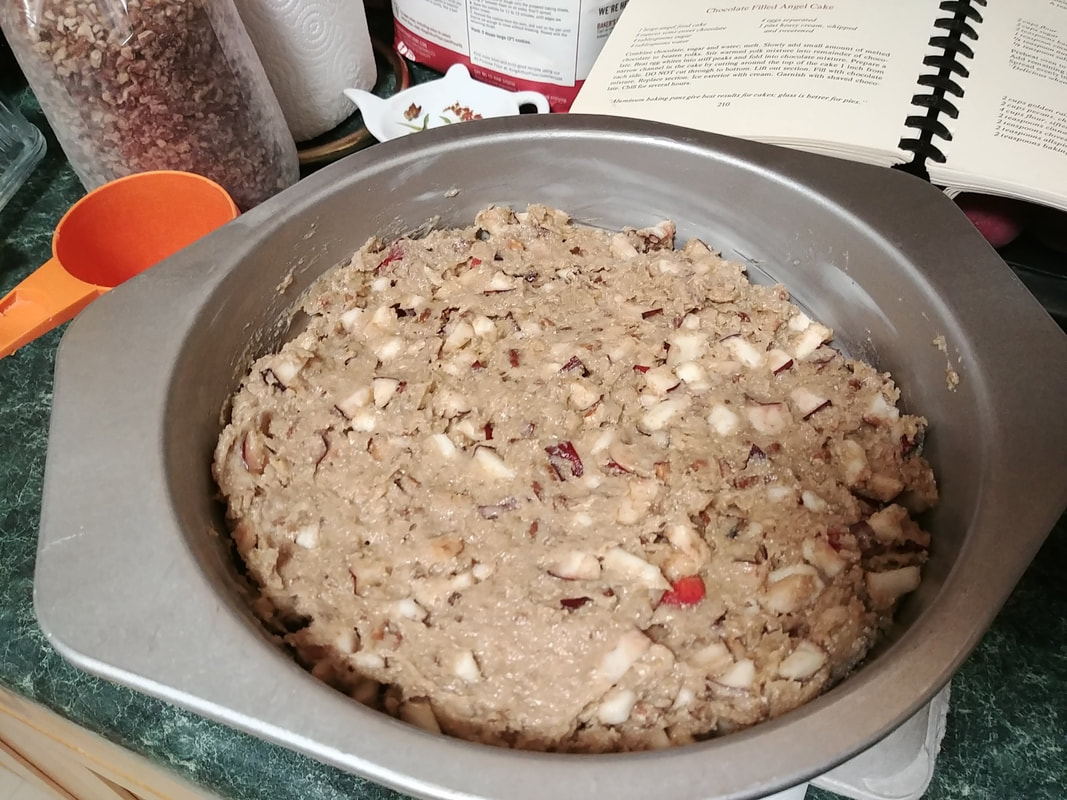 The very thick batter, replete with chopped apples and pecans, in a my well-greased, brand new cake pans! Note the bag of pre-chopped pecan pieces. Cheaper and less work than chopping whole pecans. Here's my recipe: 2 cups flour (I used 1 cup all-purpose, 1 cup whole grain rye) 1 1/2 cups sugar 2 teaspoons baking soda 1 teaspoon cinnamon 1/2 teaspoon freshly grated nutmeg (or thereabouts) 1/2 teaspoon salt at least 4 cups apples, finely diced 1 cup chopped pecans 1/2 cup butter, softened 2 eggs, slightly beaten Preheat oven to 325 F and grease two 9 inch round cake pans. Add all dry ingredients to a large bowl and whisk to combine. Add chopped pecans and whisk to combine. Take 4-6 freshly washed Liberty apples (they will be small) - slice into thin slices and then cut crosswise to make fine dice. You can leave the skin on. Fill at least 4 cups of apples and add to dry ingredients, then cut up the rest of the apple you were slicing and add to the bowl. In a small separate bowl, melt the stick of butter slightly in the microwave (10-20 seconds) and add to the big bowl. Add 2 eggs and with a wooden spoon combine all, stirring and folding until no loose flour is left. Divide into two pans and bake 45-60 minutes or until the cake springs back in the center to the touch. Cool on a rack. 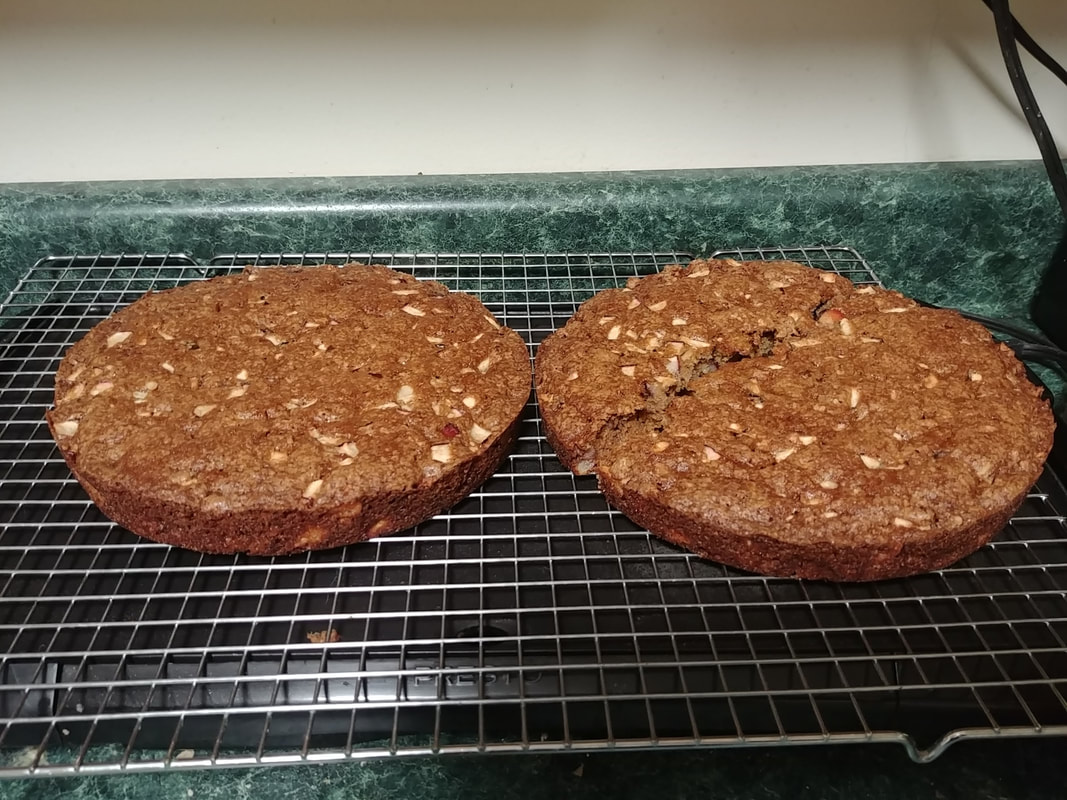 The baked cakes cooling on a rack (set on top of my electric griddle, lol). Try not to break yours like I did, but if you do, make that the bottom layer. :D The house smelled DIVINE at this point. Salted Caramel (or Maple) Buttercream Frosting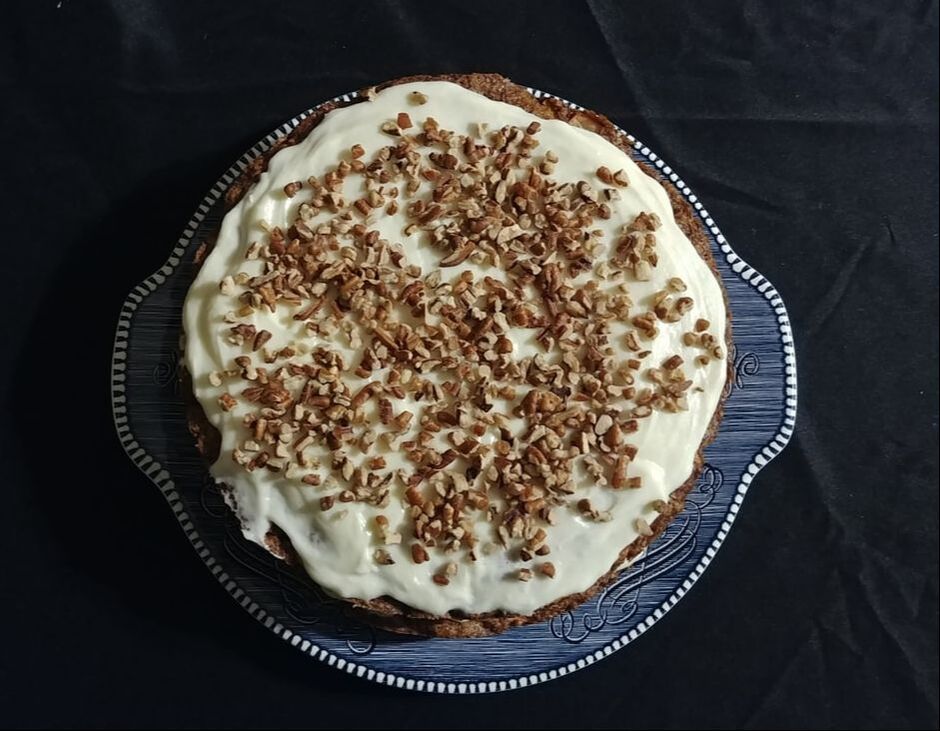 I happened to have some Monin Salted Caramel Syrup laying around the house, but if I make this again I'll probably use maple syrup and some salt. The salty-sweet frosting makes a nice (but rich) contrast to the not-as-sweet cake. 1 stick salted butter, softened 2 tablespoons to 1/4 cup syrup powdered sugar salt With a fork, beat the syrup into the softened butter. Add enough powdered sugar to make a thick frosting. Taste and add salt a few grains at a time, tasting between each addition. When the cakes are cool, frost one layer, then top with the other, and frost the top. This won't be enough to frost the whole cake, just the layers. Sprinkle more chopped pecans on top for decoration. 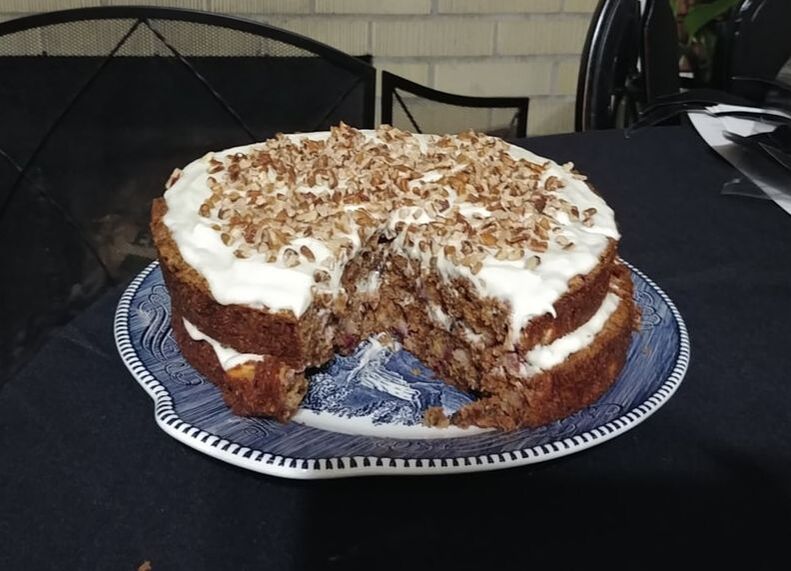 My crooked layers. 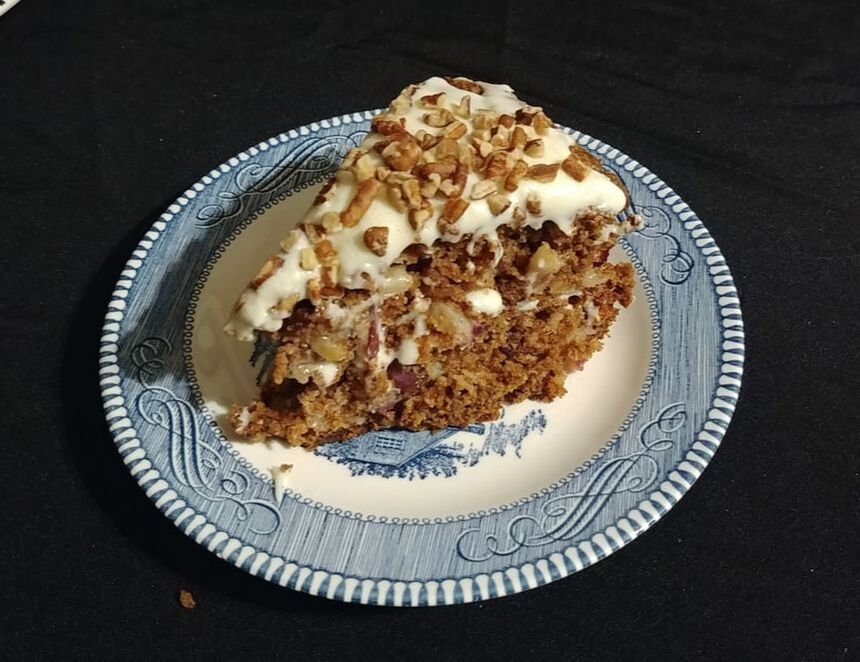 The cake is fairly light, considering it's essentially a type of fruit cake, but the frosting makes it very rich. I recommend cutting a smaller slice, unless you are eating this as a meal unto itself. A Brief History of Election CakeElection Cake is a democratic tradition that dates back to the earliest days of our Republic, even before we were officially our own country. Puritans in New England celebrated it in the 17th century, but was important throughout the 18th and 19th centuries. Election Day was once held in the spring, but in 1845 Election Day was codified to be held on the first Tuesday after the first Monday in November. Back when only propertied free white men were allowed to vote, election cake was nonetheless part of community celebrations around election day. and the similar Muster Day, a celebration from the Muster Act of 1792, which called every able-bodied man aged 18 to 45 to muster for the local militia. Generally held in September and largely in effect until after the Civil War, Muster Day often required the bribe of alcohol, and communities would often have county-fair type celebrations as well. Like Muster Day, Election Day was a community affair, and that necessitated some publicly accessible food. Election Cake is in the tradition of Medieval English great cakes - expensive and enormous confections of fine flour, sugar, expensive imported dried fruits, spices, and nuts and soaked with wine or alcohol. The New England tradition was nearly identical, only the ingredients were much less expensive by that point. Like many old-fashioned cakes, Election cake is not leavened with baking soda or baking powder - it's leavened with yeast, generally homemade yeast like potato yeast. And because it is meant to serve a crowd, the proportions are enormous. The flour and sugar are measured in pounds, as many as a dozen. The generally accepted first published recipe of Hartford Election Cake comes from Amelia Simmons' American Cookery, first published in 1796 in Hartford, CT (another run was printed in Albany, NY also in 1796). Which makes me wonder if Hartford Election Cake wasn't an homage to the state in which it was published. Election Cake began to wane in popularity as the 19th century wore on, in part thanks to developments in cake baking technology, including the development of chemical leaveners like baking soda and baking powder. But in 1889, Ellen Wadsworth Johnson published a cookbook entitled, Hartford Election Cake and Other Recipes. Notable for its inclusion of ELEVEN separate recipes for Election Cake, the cookbook is nonetheless full of more conventional recipes. The title may have something to do with the fact that it was published in Hartford, Connecticut, despite the fact that it was written as a benefit for a church in New Hampshire. In her introduction, Ellen Wadsworth Johnson notes that most of the recipes come from "manuscript sources," indicating that even in 1889 it may have been a historical document. Maybe next year I'll have the time and energy to tackle a real election cake recipe, but for the meantime, Virginia Apple Pecan Cake will have to make a good substitute, and one you can eat any time of year. Did you make an election cake this year? Election Cake Resources
The Food Historian blog is supported by patrons on Patreon! Join us for awesome members-only content like free digitized cookbooks from my personal collection, e-newsletter, and even snail mail from time to time!
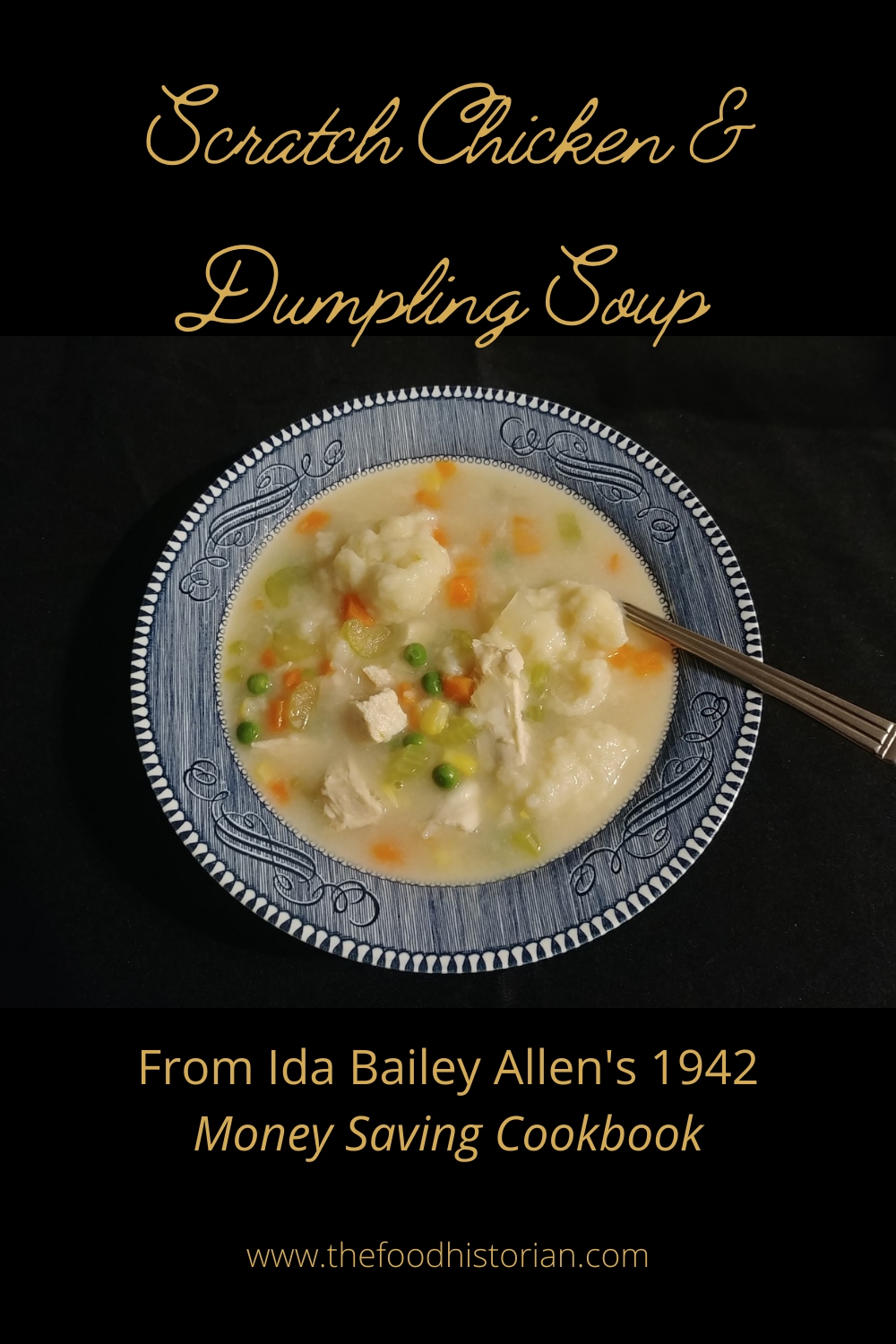 Today was a chilly VERY blustery day - my styrofoam Halloween headstone actually blew away this morning! Luckily it only blew into the side yard and wasn't too damaged. Long story short, it seemed like the perfect weather for chicken and dumpling soup. Only problem? I'd yet to find a good dumpling recipe. Until I consulted the glorious Ida Bailey Allen and her 1942 Money-Saving Cook Book. Ida Bailey Allen is one of my favorite relatively unknown celebrity cookbook authors. She was PROLIFIC and published over 50 cookbooks in her lifetime, from 1917 to the 1973 Best Loved Recipes of the American People, published the same year she died. A food writer, magazine editor, and essentially the founder of homemaker radio (she was the president of the Radio Homemakers Association), she was also the first female food TV host with her show "Mrs. Allen and the Chef" (you can listen to clip here!). 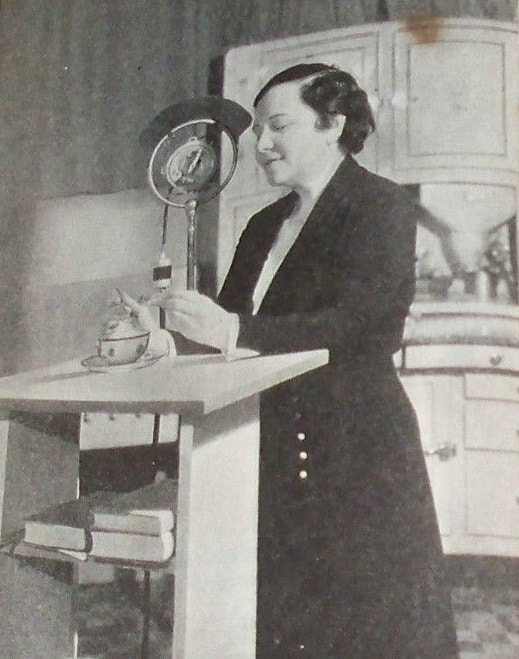 Ida Bailey Allen in her kitchen with a microphone for radio broadcasting, c. 1924. Note the awesome Hoosier cabinet in the background. One of the only moving images of Mrs. Allen that seems to survive on the internet is this little clip from the 1940s - a retrospective of the 1920s. Candy in tea! Who knew? 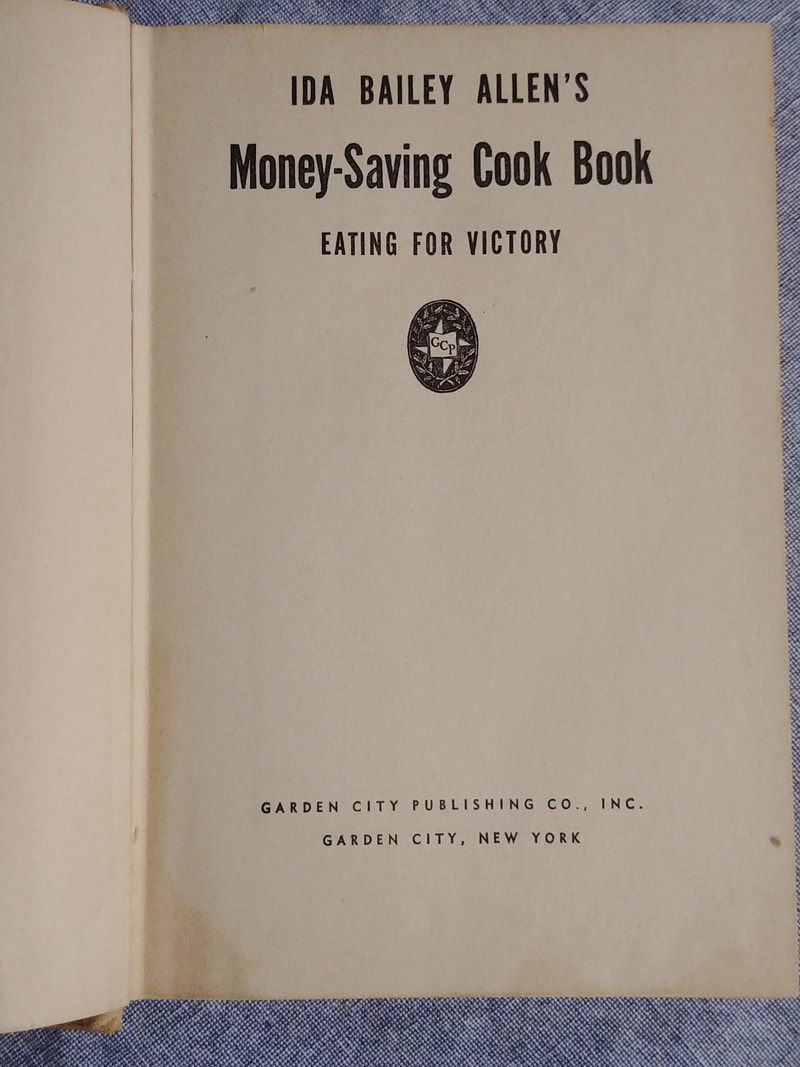 Her Money-Saving Cook Book, first published in 1940 was republished in 1942 as a Victory edition, which is the version I have. It's just a delightful cookbook - chock full of basic, easy, and inexpensive recipes, as well as a bunch of 1940s-style vegetable recipes that I can't wait to try out. So when I was on the hunt for a dumpling recipe to go with my chicken soup, this one of the first cookbooks I consulted, and it did not disappoint. First, let's start with the chicken soup. Scratch Chicken Soup1 pound chicken 5 quarts water (or 4 quarts water and 1 quart chicken stock) 1 onion 2-3 ribs celery 1 cup diced carrots 1 cup frozen peas 1 cup frozen corn (or 1 bag mixed frozen corn, peas, and carrots) salt & pepper to taste Soup is always way easier than people think. It's just a matter of adding ingredients at the right time depending on how long they have to cook. Start with the chicken. You can use boneless or bone-in, skin-on. If using boneless, substitute 1 quart of water with chicken stock for extra flavor. In a large stock pot (I used my favorite cast iron dutch oven), add the chicken, water (and/or stock), onion, celery, and carrots (if using fresh). If not using chicken broth (which is salted), add a teaspoon of salt. Bring to a boil and reduce heat to a simmer, cooking until the chicken is cooked-through and the carrots are tender. About 20 minutes. Remove the chicken from the broth, dice, and return to the pot. Add the frozen vegetables and return to a simmer. Once the vegetables are tender, voila - chicken soup. You can now proceed to the dumpling recipe. 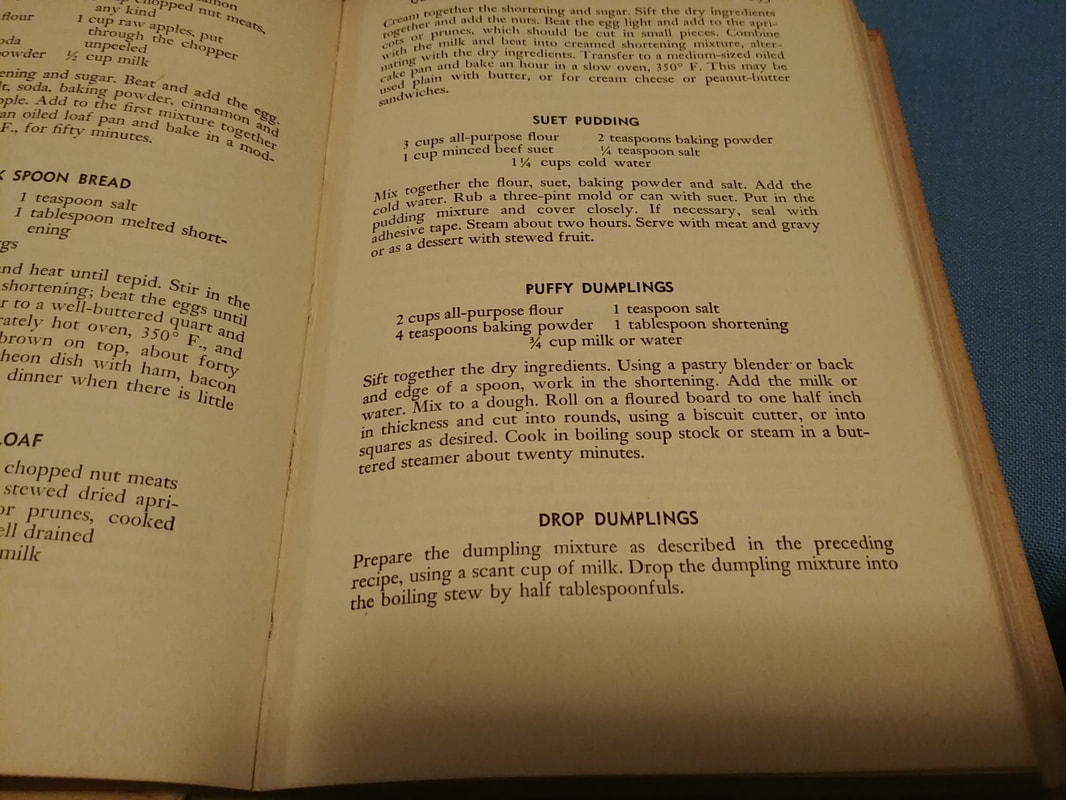 Ida Bailey Allen's Puffy Drop DumplingsI didn't want to roll out the dumplings, so I used the Drop Dumpling version of the recipe. Here's the original, which turned out pretty well! I did substitute butter for the shortening. If you use salted butter, reduce the salt in the recipe to 1/2 or 3/4 teaspoon. 2 cups all-purpose flour 1 teaspoon salt 1 teaspoons baking powder 1 tablespoon unsalted butter 1 cup whole milk Use a balloon whisk to blend the flour, salt, and baking powder together. Cut the butter into small pieces and squish in the flour with your fingers (or cut in with a pastry blender) - there should be small chunks or streaks of butter left in the floury mixture. Then add 1 cup milk. Mrs. Allen called for a scant cup, but that wasn't quite enough - my mix was dry instead of being soft. Using a regular table or soup spoon, drop bits of dough about the size of a walnut (or a little larger) into the simmering soup. There will be a lot - submerge any exposed parts under the broth to make sure they steam properly. They'll start puffing up/breaking up almost immediately. Cover the pot and simmer for about 5 minutes. The flour from the dumplings will thicken the broth nicely. 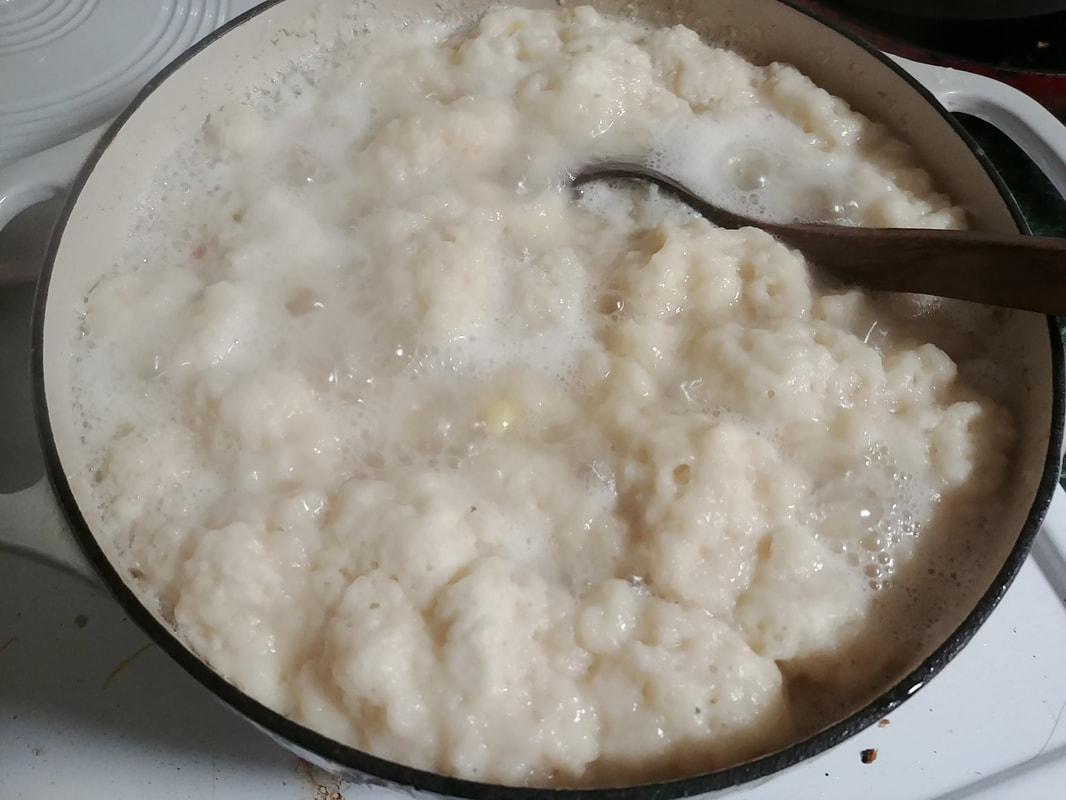 The simmering pot of dumplings. (Please ignore my messy stove!) 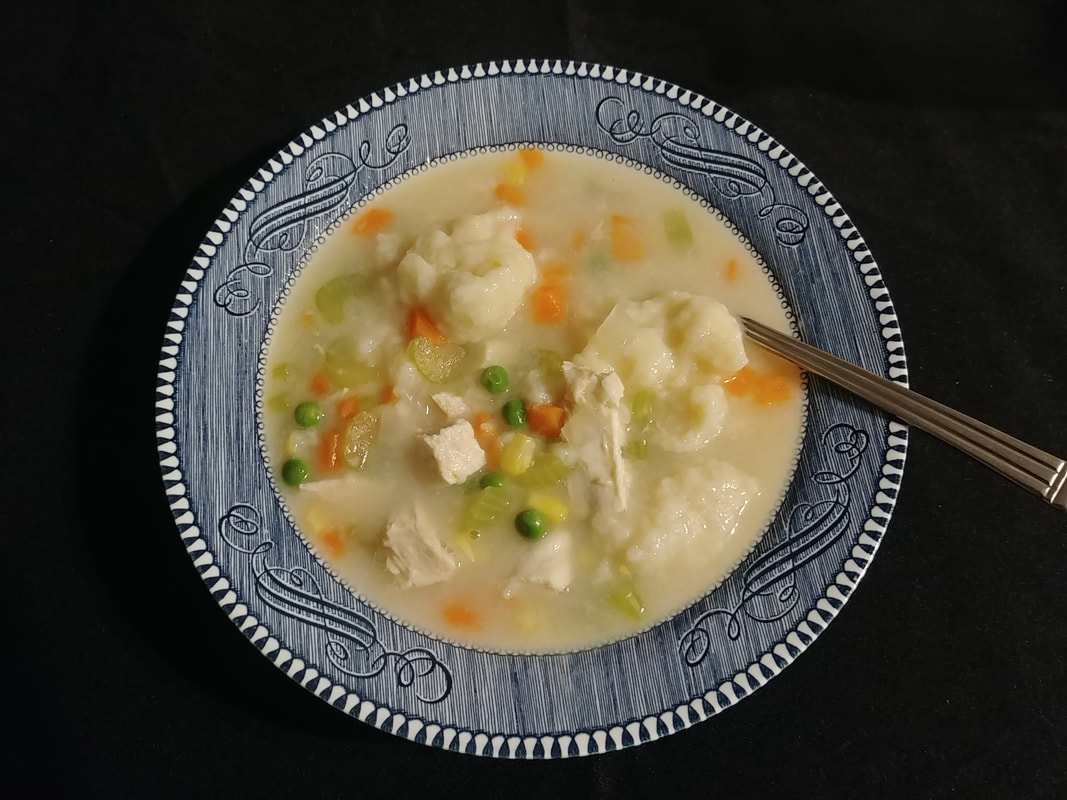 The delicious finished product. The dumplings exceeded my expectations - being a cross between that doughy chew you expect from a nice soup dumpling and light and spongy on the inside of the larger ones. All in all - a perfect one pot supper on a blustery, chilly day. The Food Historian blog is supported by patrons on Patreon! Join us for awesome members-only content like free digitized cookbooks from my personal collection, e-newsletter, and even snail mail from time to time!
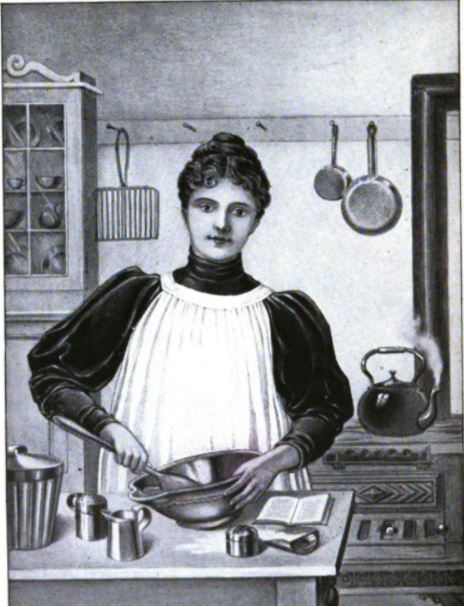 Image of a woman cooking, from the frontspiece of "Hood's Practical Cook's Book" (1897). 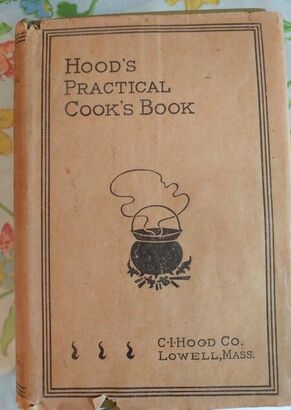 Hood's Practical Cook's Book from 1897 is one of my favorite 19th century cookbooks in my collection. It's really quite small and could easily fit in an apron pocket. My copy has the original dust jacket, which is nice. Published by C.I. Hood & Co., a Victorian patent medicine company, the cookbook is interspersed with advertisements for Hood's products, especially their famous sarsaparilla extract. I made the very successful Buttermilk Cake from this cookbook previously, and I'd been wanting to make Dutch Apple Cake for a while. Touted as a "tea cake," it was essentially a biscuit with sliced apples stuck in the dough. We've been trying to cut back on sweets, and this recipe has absolutely no sugar in it - neither for the biscuit nor on the apples, so it seemed like a perfect dessert. I also made it for our 3 year wedding anniversary. Normally we go away someplace fun, but obviously not this year, so I made my favorite roasted vegetable French lentil bowls and we had this for dessert. 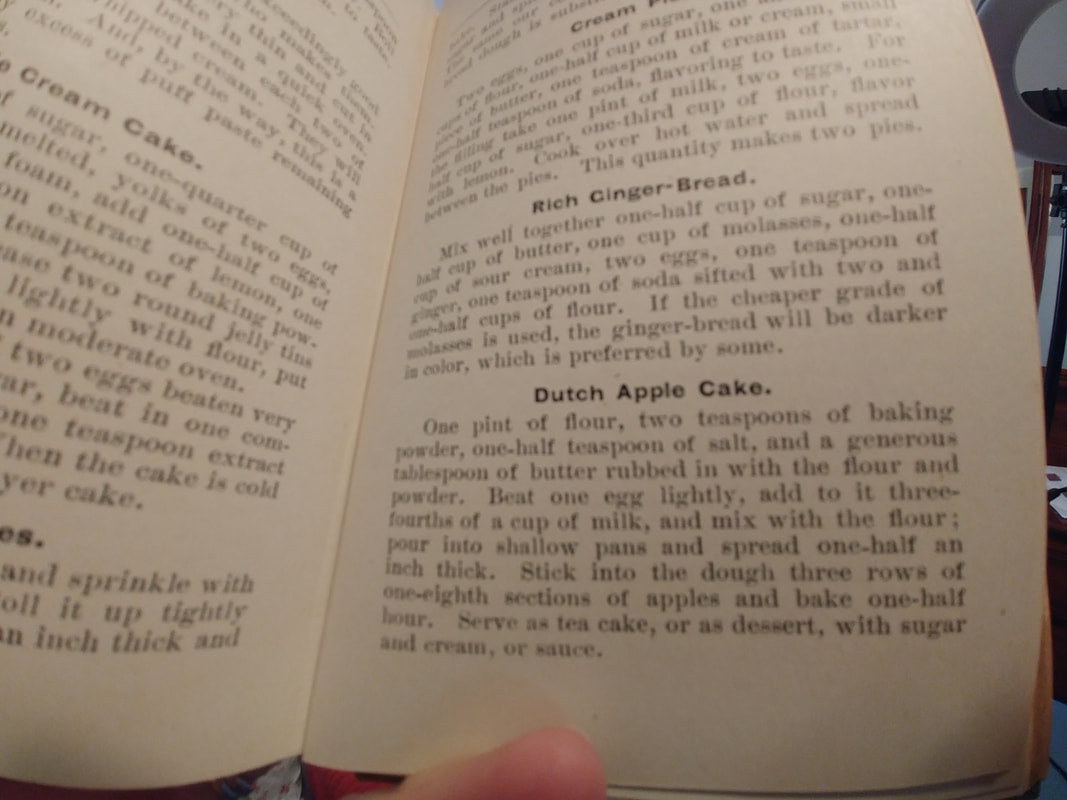 The quick snap of the recipe I took with my phone, and cooked the recipe from. I never take historic cookbooks into the kitchen! Don't want to get them dirty. Dutch Apple Cake Recipe (1897)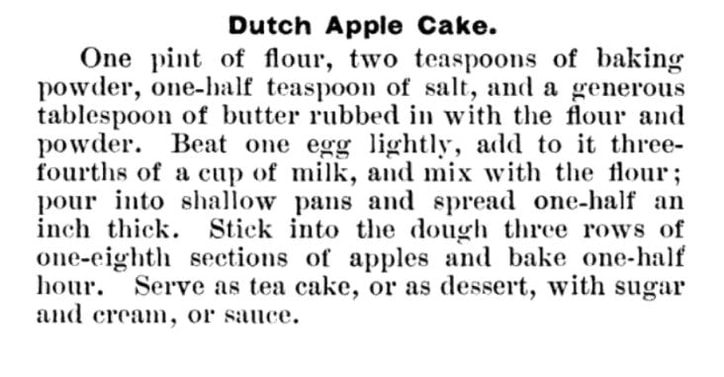 The original recipe reads: "One pint of flour, two teaspoons of baking powder, one-half teaspoon of salt, and a generous tablespoon of butter rubbed in with the flour and powder. Beat one egg lightly, add it to three-fourths of a cup of milk, and mix with the flour; pour into shallow pans and spread one-half an inch thick. Stick into the touch three rows of one-eighth sections of apples and bake one-half hour. Serve as a tea cake, or as dessert, with sugar and cream, or sauce." Here's how I translated the recipe: 2 cups flour 2 teaspoons baking powder 1/2 teaspoon salt 1 1/2 tablespoons butter 1 large egg 3/4 cup whole milk 3 smallish apples (I used Gingergold - a sweet, slightly mealy, early apple) Combine flour, baking powder, and salt and whisk to combine. Cut butter into small cubes and smush with fingers, mixing into the flour, but leaving largely intact. Whisk the egg into the milk, and pour into the flour mixture. Toss with a fork until a dough forms, kneading/folding lightly to get the rest of the flour and spread the butter, then pat into a greased quarter sheet pan. Quarter apples, core, and cut each quarter in half (to make the eighth!). I did not peel mine, and pressed into the dough as best I could on their sides. I had a few slices left over. Bake at 350 F for about 30-40 minutes until the biscuit is lightly browned and the apples are tender. Serve with sweetened whipped cream (and liquid cream, and maybe some maple syrup). 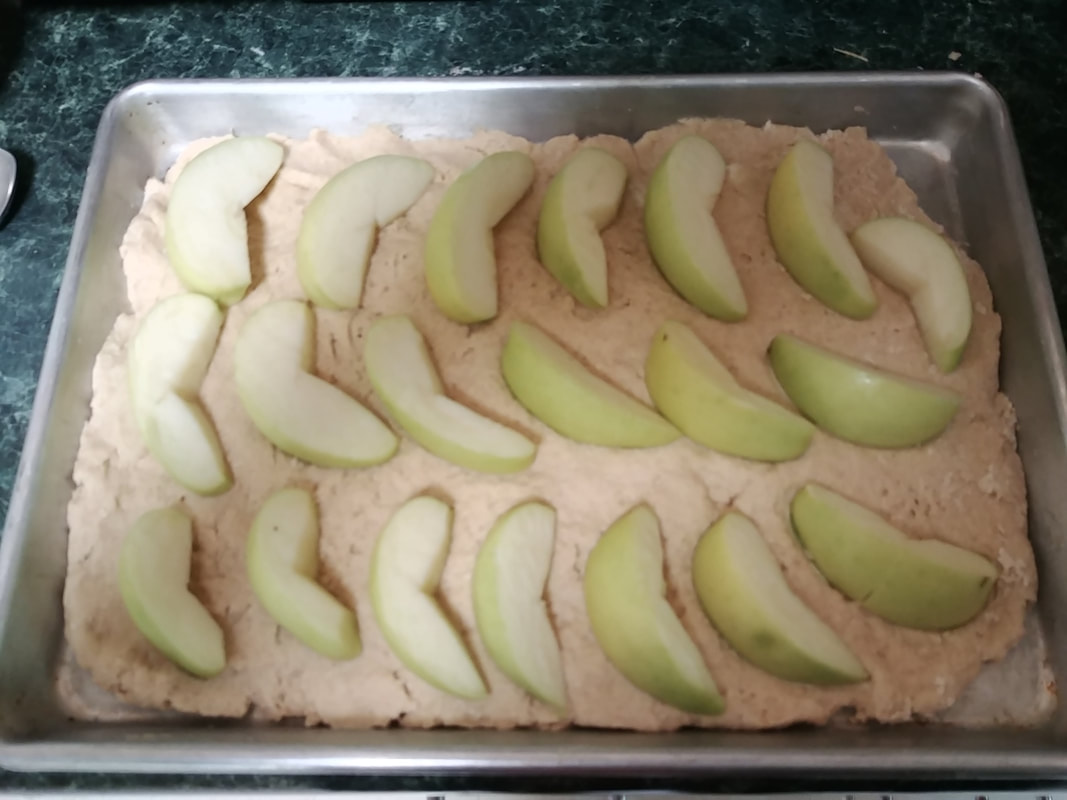 Before baking - sorry for the fuzziness, I took this in a hurry with my phone. 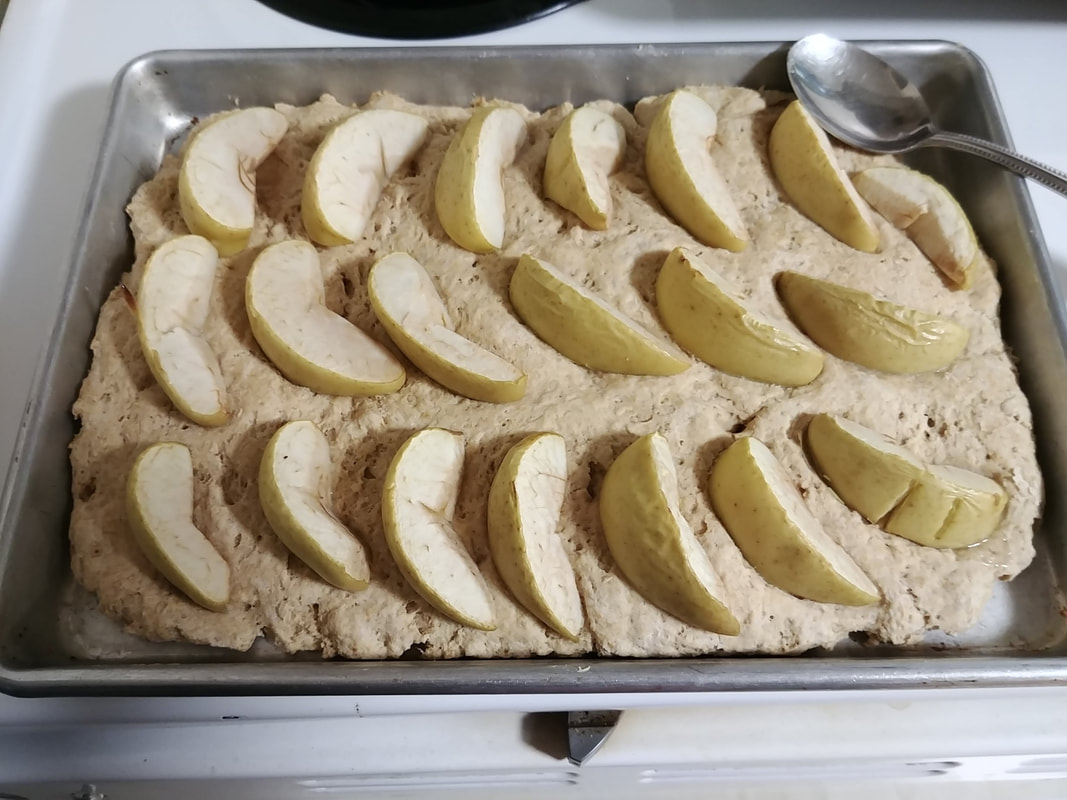 After baking - not noticeably different, just slightly browner! If you read the recipe, it seems pretty straightforwardly biscuit-y. But when you get to the middle, it says, "pour into shallow pans and spread one-half an inch thick." Sadly, my dough did NOT pour, and in fact, I had to knead it a bit to get the flour mixed in. If I had been paying closer attention, I would have added a little more milk, but I didn't! So I followed the recipe exactly. The biscuits were also a BIT flat tasting and dry - I would add a teaspoon or so of sugar and more milk (at least a cup), which I think would make something a little more batter-ish, which would presumably rise around the apples a little more. I would also space the apples closer together as they provide the only sweetness. In summation, certainly not a terrible recipe, but not great either. Basically a plain biscuit with baked apples on top. Sadly, this one gets labeled a fail! But I am going to try it again - I might also add some sweet spices like cinnamon or cloves to the biscuit dough and see if that makes a difference. And maybe chop the apples into smaller chunks - not as pretty, but easier to eat. Have you ever tried a recipe and had it fail in some way? Share your trials and tribulations in the comments! The Food Historian blog is supported by patrons on Patreon! Join us for awesome members-only content like free digitized cookbooks from my personal collection, e-newsletter, and even snail mail from time to time!
It's Juneteenth! Thanks to everyone who joined us for Food History Happy Hour. This week we make the Rose in June cocktail from the 1917 "Recipes for Mixed Drinks." We discussed Juneteenth, red velvet cake, victory gardens including propaganda and the exclusion of Black farmers and imprisoned Japanese Americans, the role of visuals in influencing taste, Black Food Historians You Should Know, disparities in book contracts, hot weather foods, salads, summer kitchens, how historical peoples coped without air conditioning, how historical peoples kept foods cold before refrigeration, ice and ice cream in the ancient world, rural electrification and electric refrigerators, the Frigidaire Cookbook, icebox pie, racial stereotypes in food advertising, including the history of the "Aunt" and "Uncle" terms, including Uncle Ben and Aunt Jemima, the history of the mammy trope, the tragedy of child caring roles, What Mrs. Fisher Knows About Old Southern Cooking, Black children in advertising, Franchise: the Golden Arches in Black America, the forthcoming book scanner I ordered, monuments and statues, and we ended with a signal boost for the James Hemings Society.
Rose in June Fizz (1917)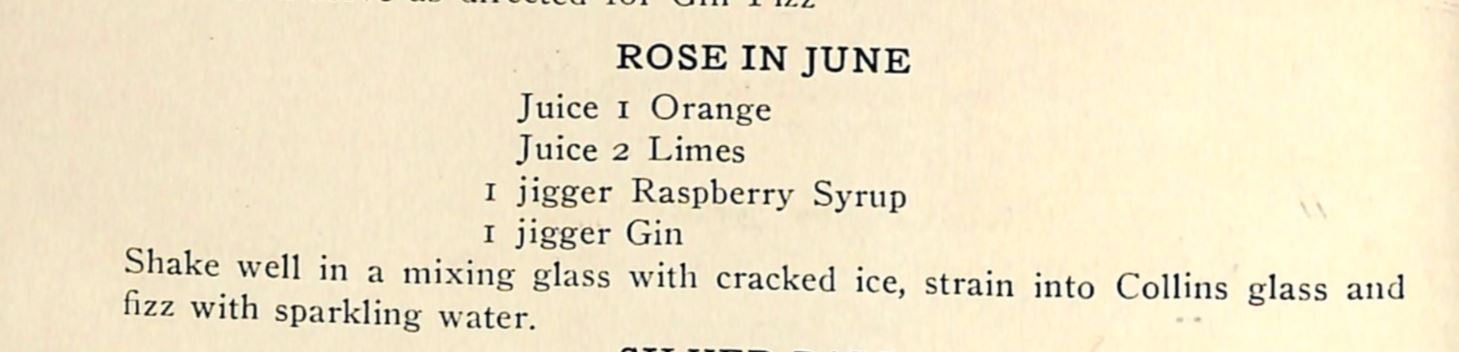
The "Rose in June" cocktail comes from the "Fizz" section of Recipes for Mixed Drinks by Hugo Ensslin (1917).
The original recipe calls for: Juice of 1 orange Juice of 2 limes 1 jigger raspberry syrup 1 jigger gin Shake well in a mixing glass (or cocktail shaker) with cracked ice, strain into Collins glass and fizz with sparkling water OR - if you don't have fresh citrus fruits OR raspberry syrup - you can substitute 1/3 cup orange juice, 1/4 cup lime juice, a heaping tablespoon of raspberry (or in my case, strawberry) jam, and the gin. Very nice, very refreshing, but sadly NOT pink.
Here's a roundup of links related to everything we talked about (in addition to all the links above!):
If you liked this post and would like to support more Food History Happy Hour livestreams, please consider becoming a member or joining us on Patreon. Members and patrons get special perks like access to members-only content.
Thanks to everyone who joined me on Friday for Food History Happy Hour live on Facebook. This week we discussed the role of riots and boycotts in history and food history, touching primarily on the food boycotts and riots and high cost of living protests of 1916/1917 which occurred around the globe. We also talked about women's suffrage and farmerettes, midnight suppers, Frank Meier, inventor of the bees' knees cocktail and his role in WWII, poison candy and the Pure Food and Drug Act of 1906, food and riots or protests, including the role of food and cooking in the Civil Rights movement, Laura Ingalls Wilder and the Little House Cookbook, L. M. Montgomery, requests for next week, and a brief introduction to the history of gelatin, beaten biscuits, and other formerly upper-crust foods which became inexpensive convenience foods. If you want to watch back episodes you can check them out on right here on the blog or I am hoping to upload full episodes to YouTube now that my channel is officially verified! Bees' Knees Cocktail (1936) Bees' Knees recipe from "The Artistry of Mixing Drinks" by Frank Meier. Note the little "FM" monogram everywhere. In 1936 Frank Meier published "The Artistry of Mixing Drinks," a beautifully designed little bartender's guide based on his time as the head bartender at the Hotel Ritz Carlton's Cafe Parisian, which opened in 1921. Frank had purportedly trained at the Hoffman House in New York City before taking on his new role at the Ritz. He served as head bartender and host for over twenty years and even played a role in the French Resistance during WWII, when the Ritz became German headquarters. Meier was a well-known originator of cocktails, including the famous "Bees' Knees," which he invented sometime in the 1920s. It became popular in the United States during Prohibition, likely because the honey and lemon masked the taste of bathtub gin. Frank's original recipe reads: "In shaker: the juice of one-quarter Lemon, a teaspoon of Honey, one-half glass of Gin, shake well and serve." A more modern recipe might be: Juice of 1/4 lemon (or half a tablespoon) 1 or 2 teaspoons of honey 1 or 1 1/2 ounce gin Shake over ice and serve in a cocktail glass. One teaspoon of honey definitely wasn't enough for me - I couldn't taste the honey at all! Perhaps "a dollop" might be a better descriptor. Here are some resources on some of the topics we discussed tonight:
Next week we'll be discussing Easy Bake Ovens, Jello and aspic, foods of the 1950s and '60s, and all sorts of other fun stuff. See you then! If you liked this post and would like to support more Food History Happy Hour livestreams, please consider becoming a member or joining us on Patreon. Members and patrons get special perks like access to members-only content.
|
AuthorSarah Wassberg Johnson has an MA in Public History from the University at Albany and studies early 20th century food history. Archives
September 2023
Categories
All
|
 RSS Feed