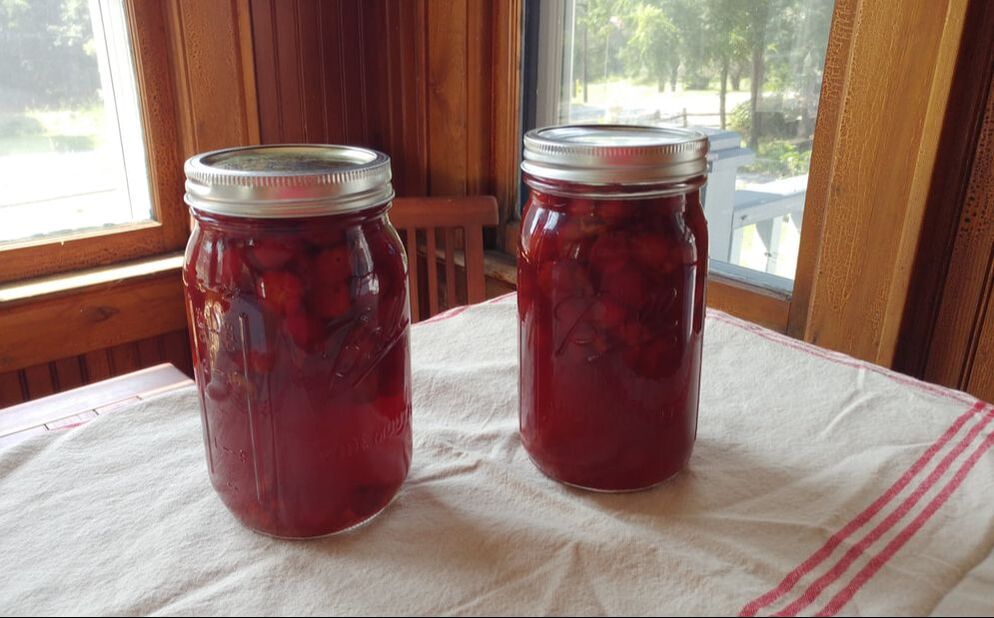
 Remember my post about George Washington and cherries in February? It's been one of my most popular. And while yes, you can totally still make walnut pie or have pickled walnuts with cheese and Madeira in February, you can also take the time right now to make yourself some Cherry Bounce. What is cherry bounce, you ask? It's basically brandy, cherries, and sugar, and it was a favored 18th century drink. My in-laws have a now quite grown up sour cherry tree (Montmorency, I think) that was just LOADED with sour cherries when we were up the other weekend. Sour cherries, also known as sour pie cherries, are not as sour as, say, rhubarb, but definitely need a little sugar as they are nowhere near as sweet as the sweet black or Queen Anne cherries you often find in grocery stores this time of year. They're also far more delicate, so if you're going to pick them, please pick them with the stem on, unless you plan to process them right away. Martha Washington's recipe is available thanks to the Mount Vernon estate, but I didn't have 10 pounds of cherries, and while mine probably weren't Morellos, Montmorencies are a sub-genus of Morellos. I also thought 3 cups of sugar to 4 cups of brandy was pretty high. That's borderline syrup territory, for my taste. Considering I wanted to use this cherry bounce as a sipping liquor or in cocktails, I reduced the sugar. I also wanted to taste some of that summer flavor, so I left out the spices. Here's what I used: 1 colander sour cherries (a little more than 1 quart, pitted and stemmed - feel free to use more) a little more than 1 cup sugar 1 liter smooth brandy (not the expensive kind, but not the cheapest either) Place 1/2 cup sugar in each of two quart jars. Pit the cherries and divide equally between the jars (you'll get about a pint for each). The easiest way to do this, since sour cherries are so soft, is just to squeeze the pits out over the jars, to make sure you catch all the juice. Discard the pits. This is also easier if you use a canning funnel for each jar, which helps with the splatters. Because Montmorency cherries have yellow flesh, if you wear dark clothing, the spattering won't stain. Once the cherries are done, add 2 cups of brandy to each jar. You'll have a little left over, so just divide the remainder between the two jars. I added another couple of tablespoons of sugar to each, because I had room. Screw the mason jar lids on and shake every hour or so until the sugar is dissolved. Then let rest in a cool dark place, shaking occasionally, until February. I left the cherries in, and intend to either serve one with each glass, or strain them out and cook them in more sugar and serve over vanilla ice cream (Thomas Jefferson's favorite). Funnily enough, although the mixture was brown last night, by morning it was bright red and the cherries were already starting to lose their color. We'll see how it turns out. I might regret not adding more sugar or cherries, as sugar tends to mellow out alcohol, but then again, I might not! I'll give an update for President's Day 2020, when I'll invite some friends over for cherry bounce, walnuts, and ice cream! 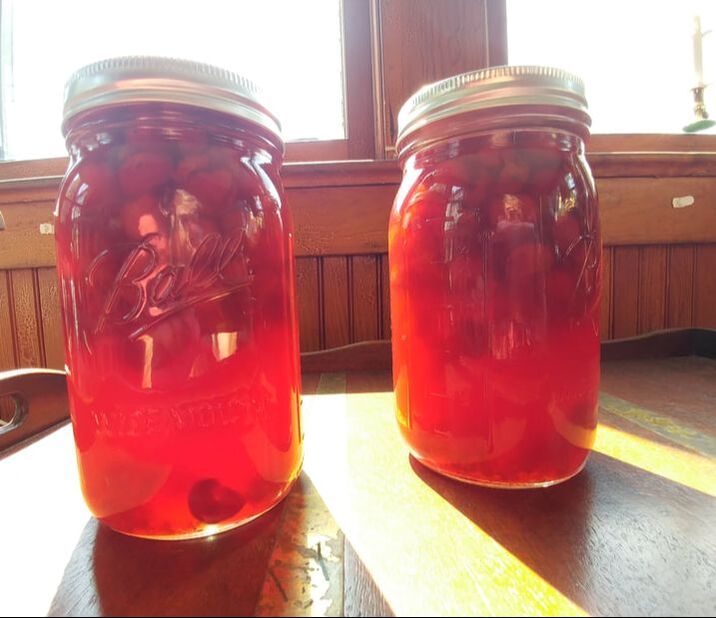
0 Comments
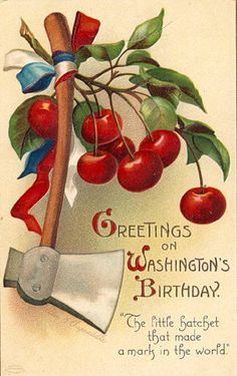 Happy Presidents' Day, everyone! Originally celebrated on February 22nd, which is George Washington's birthday, President's Day was consolidated with Abe Lincoln's in 1971 and every year food blogs are inundated by everything cherry in George's honor (poor Abe gets little mention at all, and you can just forget about all the other Presidents). The story goes that little George "barked" a cherry tree as a child and couldn't "tell a lie" to his father, admitting the deed. Cherries have been a symbol of George ever since. But did the poor barked cherry tree actually exist? Most historians say no, given that the story first appeared in a later edition (but not the first) of a biography published some years after Washington's death. Although some historians argue that it is, in fact, likely to be true, given that none of George's (i.e. Martha's) children ever disputed it. But did George ACTUALLY like cherries? The story goes that cherry pie was his favorite, and thus cherry pies are served in his honor all over the country. But was it? A search of Washington's papers for "pie" brings up only a couple of mentions, all referring to "Christmas pie." Searching for "cherry" brings up hundreds of hits - all about Washington planting cherry trees of all difference varieties at Mount Vernon. So he certainly liked cherries. But cherry pie? Pie was a common way to turn fruit into dessert in the 18th century and was much easier to make in the days of open-hearth cooking than the more complicated cakes. Cakes were also much more expensive, being leavened with numerous, long-beaten eggs and calling for large amounts of butter, sugar, and spices. Pies, on the other hand, were made with lard and a little flour, with a cooked fruit filling, which may or may not have been sweetened. Pies could also be sweetened with the much cheaper honey, molasses, or maple syrup. They were also a lot faster to make and less likely to scorch in a dutch oven over coals or inside a beehive oven. So it is possible that Washington ate a fair number of cherry pies in his day. But the thing about cherries is that they aren't even remotely in season in February. Martha Washington did record a recipe for preserved cherries. And cherry bounce, a sort of homemade cherry brandy, was popular in the 18th century. But cherry pie for George's birthday? Not likely, unless it was made with those preserved cherries. If you ask the folks at Washington's Headquarters State Historic Site in Newburgh, NY (not too far from where I live), they'll tell you that Washington's favorite food was walnuts. Which crops up (no pun intended) in the tree planting sections of Washington's papers just as often, if not more so, as cherry trees. Another Washington legend says he could crack walnuts with his bare hands. Which with English walnuts (his favorite) is quite easy. Native American black walnuts, however (those most readily available to George), are a different story. Most people crack those by running their cars over them. With their British heritage, George and Martha may have made pickled walnuts, which are made in June when black walnuts are still green and the nut hulls haven't fully formed yet. The pickled green nuts (recipe here) are eaten whole (hull and all!) with cheese. In the 18th century cheese and nuts with fruit was a common "dessert course." They'd probably go great with some preserved cherries and cherry bounce. If you'd rather celebrate George with a dessert, try the slightly more accurate Martha Stewart's walnut pie (though what you'd substitute for corn syrup I'll never know). Or bake Martha Washington's "Great Cake," which would have been eaten at Christmastime (maybe a few slices were left by February?). But keep in mind that, according to Martha's grandson Custis, George may not have even liked dessert all that much. Custis wrote, "He ate heartily, but was not particular in his diet, with the exception of fish, of which he was excessively fond. He partook sparingly of dessert, drank a home-made beverage, and from four to five glasses of Madeira wine." Maybe fish in Madeira would be a better dish to celebrate Washington? Certainly cherry bounce counts as "a home-made beverage." Really, whole walnuts, cheese, and preserved cherries with a glass of cherry bounce or Madeira would be the most accurate "dessert" to reflect George's predilections. If you'd rather, go ahead and celebrate Abe Lincoln instead. Apples, corn cakes, bacon, and gingerbread men were among his favorites. If you'd like to know more about Abe and his penchant for helping Mary in the kitchen, check out Rae Katherine Eighmey's Abraham Lincoln in the Kitchen or listen to this interview from NPR. However you celebrate our past Presidents, just remember that when it comes to the past, culinary or otherwise, our American mythology isn't always accurate. Happy eating. Happy Presidents' Day. The Food Historian blog is supported by patrons on Patreon! Join us for awesome members-only content like free digitized cookbooks from my personal collection, e-newsletter, and even snail mail from time to time!
Check out the VERY FIRST episode of my brand new podcast, History Bites. Every month or so we will explore a new food history topic. This month's subject is the food of pirates, just in time forInternational Talk Like a Pirate Day, which is September 19th. Enjoy!
Roly Poly Recipe
Plum duff is sometimes also called roly poly. Here is a Victorian recipe adapted from The Victorian Kitchen Book of Pastries & Puddings that uses suet in the crust.
1 1/2 cups finely chopped beef suet 2 1/4 cups flour 1 1/4 cups cold water 1 cup raisins 1/4 cup warm water In a small saucepan, heat the raisins and water over low heat until the raisins plump and thicken. There should be little water left. Mash with a fork or run through a food grinder to make a paste. With a fork toss the suet and flour together, then gradually mix in water, handling lightly. When a coarse dough starts to form, pat together with hands, kneading once or twice, and roll out into rectangle. Spread raisin paste over rectangle and roll up lengthwise to form a long roll. Seal edges with a little water and place seal-side down on a greased baking sheet in a hot oven (400 F) for about 30 minutes or until pastry is nicely browned. Serve hot or cold plain or with a pouring custard. Pease Porridge Recipe
1 pound dried split yellow peas
1/2 pound salt pork, finely diced and rinsed Soak peas in water to cover overnight. Drain and place with salt pork in a stock pot with plenty of water. Bring to a boil then reduce heat and simmer for 2-3 hours or until peas are very soft and as thick as you like. Porridge will thicken as it stands. Serve hot or cold with ground pepper and hard tack. Eat Like a Pirate Bibilography
Here are some of the wonderful books and resources I consulted in making my first ever podcast.
Feeding Nelson's Navy: The True Story of Food at Sea in the Georgian Era by Janet MacDonald "Food at Sea in the Fighting Age of Sail" from British Food in America Congotay! Congotay! A Global History of Caribbean Food by Candice Goucher |
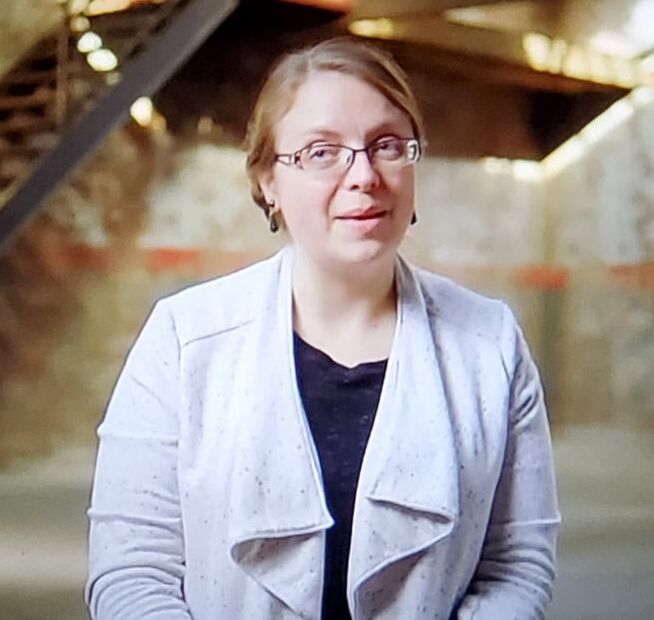
AuthorSarah Wassberg Johnson has an MA in Public History from the University at Albany and studies early 20th century food history. Archives
July 2024
Categories
All
|
 RSS Feed