|
Thanks to everyone who joined me last night for Food History Happy Hour live on Facebook. This week we made the Black Stripe cocktail - really a hot toddy - from the Roving Bartender (1946). We discussed unusual historic and heirloom vegetables, terrapin and mock turtle soup, the Victorian obsession with game meats, veal, the origins of Caesar salad, springtime greens and foraging, vegetable species diversity and gardening, heirloom grains, the centralization of American food production, tanneries and slaughterhouses, Laura Ingalls Wilder, and updates on my book! Black Stripe Cocktail (1946)I have to admit, this was not my favorite cocktail, but I think it might be that I am simply not a fan of hot toddies. As friend and bartender Mardy and I agreed, "That's a toddy! Hot watery alcohol." Lol. 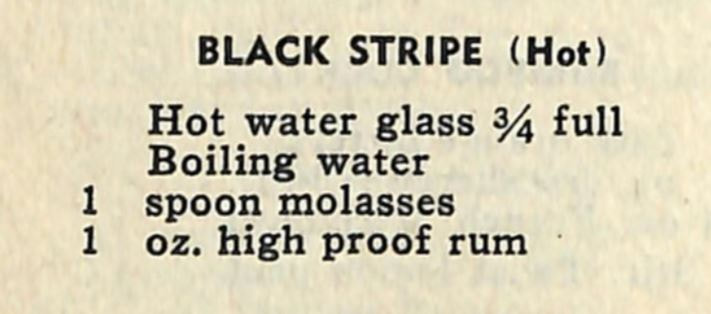 Black Stripe Cocktail from "The Roving Bartender" by Bill Kelly (1946). Fill a hot water glass (or an Uffda mug) 3/4 full with boiling water Add 1 spoon of molasses 1 ounce high proof rum (OR 1 1/2 ounces apple pie moonshine) Stir and drink while hot. If you liked this post and would like to support more Food History Happy Hour livestreams, please consider becoming a member or joining us on Patreon. Members and patrons get special perks like access to members-only content.
0 Comments
Thanks to everyone who joined me last night for Food History Happy Hour live on Facebook. This week we used the celery gin I made last week in a choose-your-own-adventure cocktail! Although I could not find any historic references to celery gin, I did find celery bitters, and several other gins that were made by steeping botanicals in gin, including tansy, wormwood, and pine log slivers (yes, really). We discussed historic sauces, peanuts and soybeans, tomatoes, the reasons why flavor extracts and bitters are only available in grocery stores, not liquor stores, ramps, victory gardens, I showed off some of my new cookbook acquisitions, and we discussed comparisons between now and historic pandemics. Celery Gin Recipe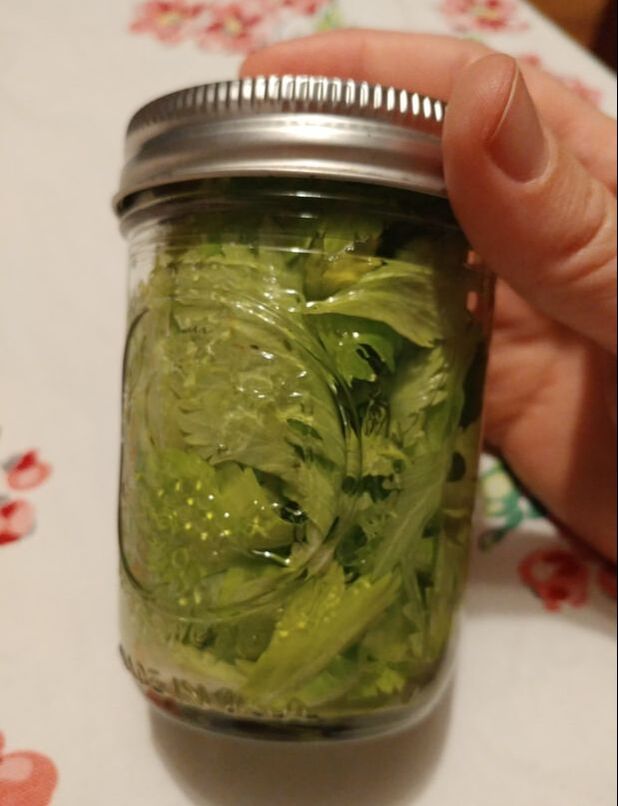 I wasn't sure how the celery gin was going to turn out, so I used a half pint jelly jar to make mine. Washed celery leaves and tops gin to cover Place celery leaves and tops in a mason jar small enough to hold them so that they mostly fill the jar. Cover with dry gin, screw on lid, and store in a cool dark place for 24-48 hours. Remove celery and discard. Gin will keep indefinitely. Blood Orange Celery Gin CocktailJuice of one blood orange 1/2 to 1 teaspoon sugar 1 ounce gin Shake over ice and serve in a cocktail glass. 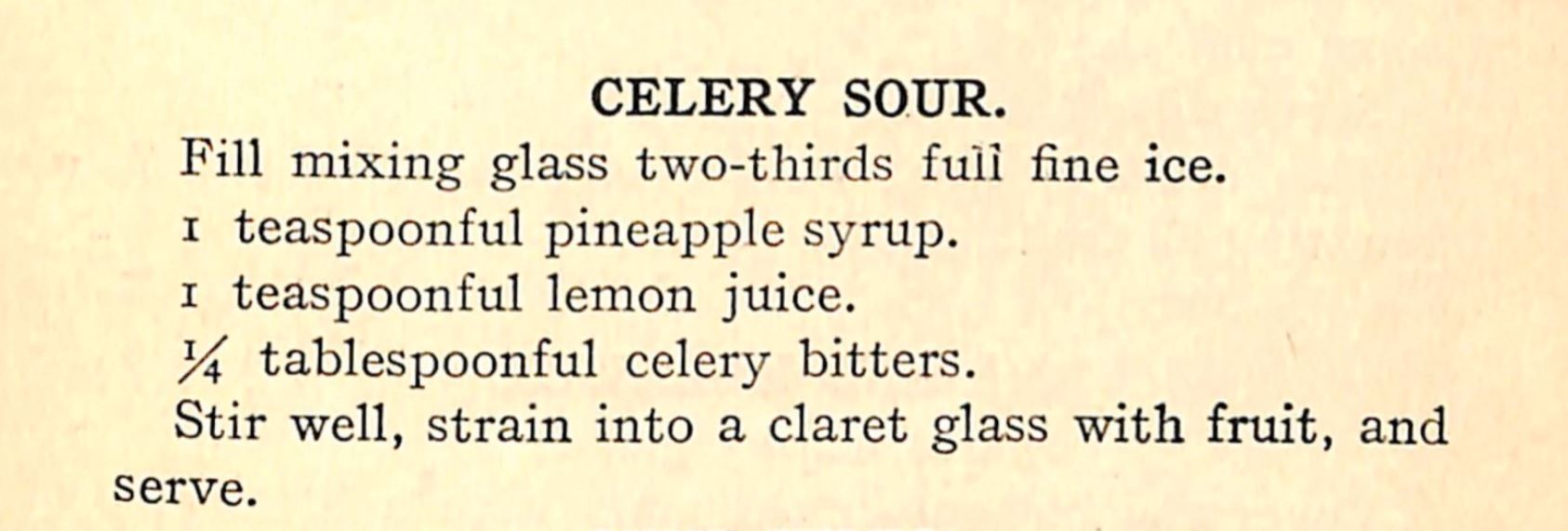 Cocktail recipe for "Celery Sour," containing celery bitters from "The Complete Buffet Guide, or, How to Mix All Kinds of Drinks" by V. B. Lewis (1903). 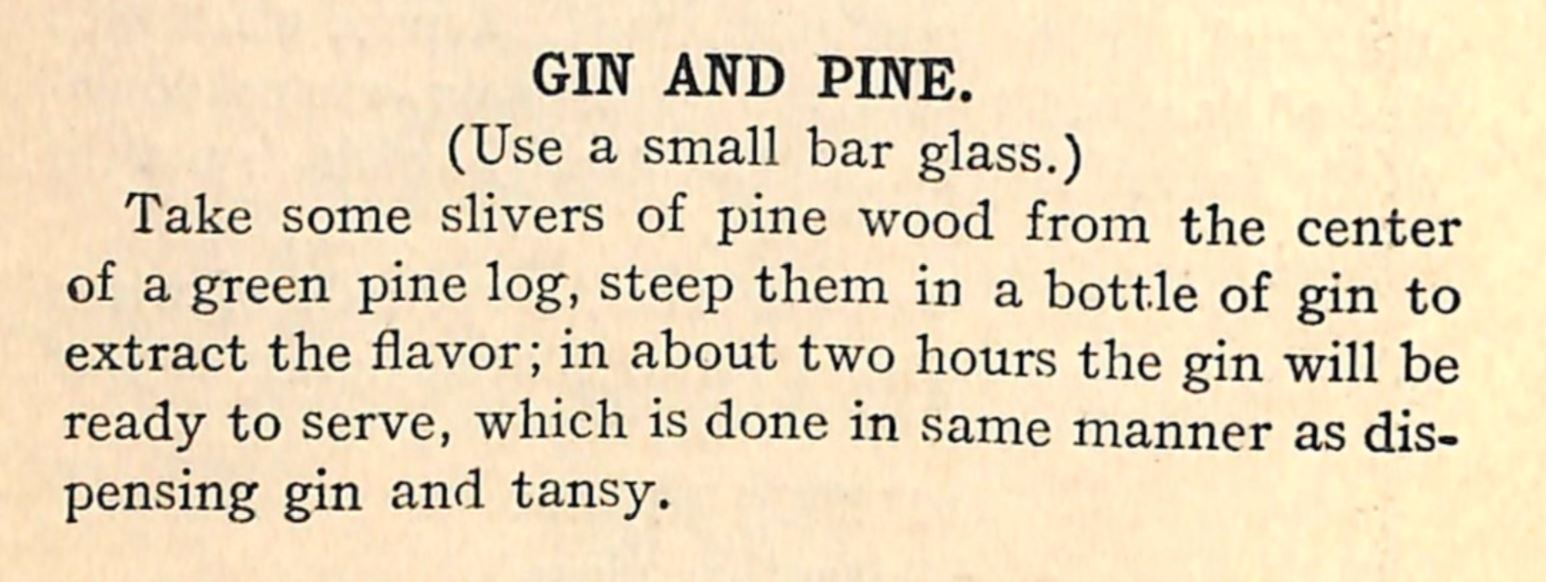 Recipe for "Gin and Pine," from "The Complete Buffet Guide, or, How to Mix All Kinds of Drinks" by V. B. Lewis (1903). For the recipe for Gin and Tansy as well as Gin and Wormwood, click the image and it will take you to the correct page. And here we have a few of the inspirations for this week's choose-your-own-adventure cocktail, from "The Complete Buffet Guide, or, How to Mix All Kinds of Drinks" by V. B. Lewis (1903). If you liked this post and would like to support more Food History Happy Hour livestreams, please consider becoming a member or joining us on Patreon. Members and patrons get special perks like access to members-only content.
Thanks to everyone who joined me last night for Food History Happy Hour live on Facebook. This week, inspired by the cold, rainy weather we've been having lately, we "visited" the American Southwest with help from the Desert Healer cocktail from the 1946 Roving Bartender. We discussed Mexican food in America, including the cookbook California Mexican-Spanish Cook Book, published in 1914 by home economist Bertha Haffner-Ginger. We also talked about burritos, corn and nixtamalization (including hominy and tortillas), savory fruit salads, sauces, including celery sauce, macaroni and cheese, 19th century pickles, jicama, pickled herring, lutefisk and cod (small correction, mahi-mahi is dolphinfish, not tilapia), and we decided that next week's topics will be 19th century sauces and pickles!
Although cocktails called "Desert Healer" are all over the internet, I couldn't find any history behind either the name or the cocktail. I'm guessing it's just one of those cocktails that someone made up and it took off. If you like your cocktails on the sweeter side, but still with some complexity of flavor, you will probably love this one.
I found this recipe in the Roving Bartender (1946). I did get the recipe slightly wrong and only did a third of an ounce of cherry brandy, but more cherry brandy would have been even better! Desert Healer Cocktail (1946)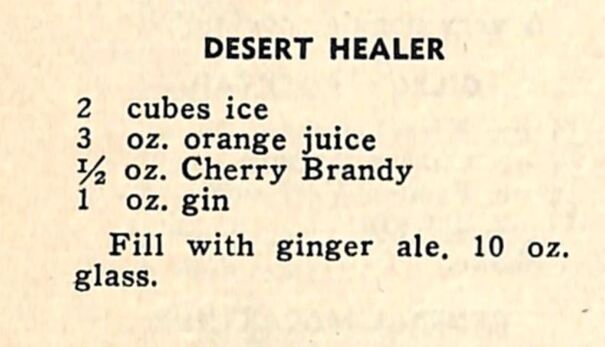
2 cubes ice
3 oz. orange juice 1/2 oz. cherry brandy 1 oz. gin (I used American gin, but any is fine) Place ingredients in a 10 oz. glass in order, then fill with ginger ale. Drink with a straw. I found this to be quite delightful and would definitely make it again, especially since it's such a nice way to use up the cherry bounce I made. 
And, of course, given all of our discussion of celery and someone's idea that I make a cocktail with celery sauce (yuck), I thought that infusing gin with celery was a delightful idea, and it just so happened that I had cut up the remains of a head of celery for crudite to go with supper. So I had lots of delightfully fresh leaves and a few stalks leftover. Into a half pint jar they went with some gin poured over top and we'll let it steep until next week, when I'll have to decide what kind of gin cocktail I want to make with it.
As mentioned last week, the bar cabinet tour is still on the list, but I might do a recorded tour instead of a live one as I think it will be easier to manage. So stay tuned, and hope to see you all next week!
If you liked this post and would like to support more Food History Happy Hour livestreams, please consider becoming a member or joining us on Patreon. Members and patrons get special perks like access to members-only content.
Thanks to everyone who joined me last night for Food History Happy Hour live on Facebook. This week, with some trepidation, I entered into the territory of raw egg and alcohol with the Cherry Brandy Flip - made with some of my homemade cherry bounce!
Plus, we talked about bananas and banana bread, tonic water, Midwestern food, beer, and more! Special discussion of candle salad. Proceed at your own risk.
Brandy flips are quite old, and I found a reference to them in The American Bartender, or, the Art and Mystery of Mixing Drinks (1874). There are several flip recipes in there, actually. But I went with the brandy one because I wanted to use up some of my cherry bounce (which is really a cherry brandy), and also because it was requested by Food Historian fans.
The term "flip" is quite an old one, and originally referred to a mixture of ale, sugar, and spices heated with a hot iron poker, which cause the drink to froth or "flip." Later, eggs were added, and eventually, the cocktail shaker was exchanged for the hot poker. The first printed recipe was published in Jerry Thomas's 1862 Bar-Tender's Guide. Known as the father of American mixology, Thomas listed a number of variations on the flip, including the "Cold Brandy Flip." Flips are similar to eggnog, but not quite the same as they do not contain cream, as eggnog does. But the flavor profile is similar. Flips have fallen out of fashion in most bars, in large part because they require the use of a raw egg. Historically, eggs were not washed before being sold, and the protective coating on the shell protected them from contamination, including salmonella. Today, eggs are washed before being sold, removing the protective coating, and opening them up to the possibility of salmonella contamination. Some people claim that the alcohol "cooks" the egg, and hot water (or hot poker) in the hot flips certainly does. But please keep in mind that you proceed at your own risk if you choose to replicate this cocktail. I thoroughly washed my egg again, just to be sure, and used a pastured, free-range, local egg. But you never know. 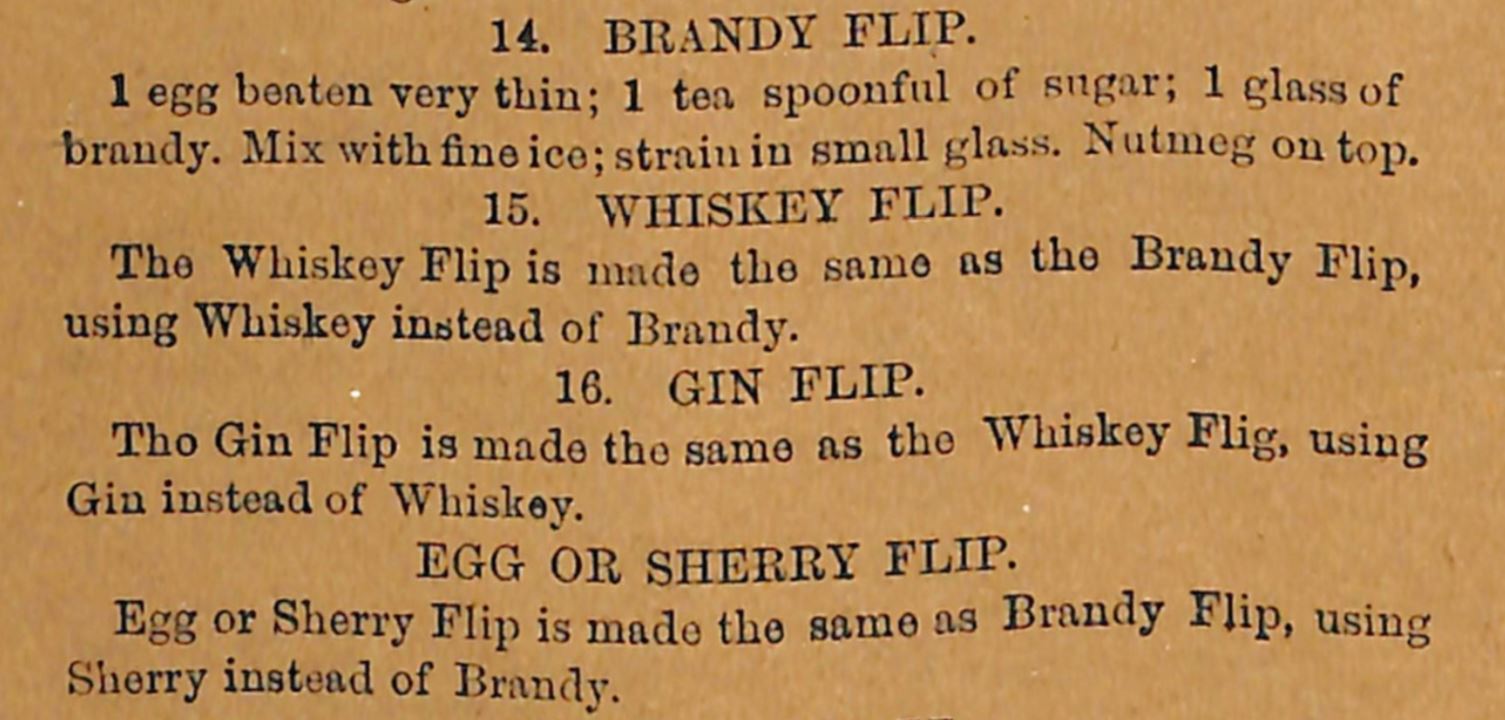
Flips, from, "The American Bartender, or, the Art and Mystery of Mixing Drinks" (1874).
Cherry Brandy Flip
1 whole egg
1 jigger (1 1/2 oz.) cherry brandy 1 oz. simple syrup cracked ice freshly grated nutmeg Place the egg, brandy, and simple syrup in a cocktail shaker WITHOUT ice (this is called a dry shake). Make sure to seal the shaker well. Shake thoroughly until your arms are tired. This emulsifies the egg. Add cracked ice, and shake again, until your arms are tired. Strain into a small wine glass or generous cocktail glass, and grate fresh nutmeg on top. This was better than I expected, although it does taste a bit "eggy" - probably those lovely free range eggs I used. If I made it again, I would add the nutmeg before shaking, or stirring it in. The egg not only emulsifies into something fairly creamy, it makes a frothy head as well. As for the Food Historian Happy Hour Livestream, we MIGHT be doing a tour of my vintage bar/liquor cabinet next week AND, I got a new, higher quality camera for livestreaming. So you can look forward to way less pixelation. Hope to see you next week!
If you liked this post and would like to support more Food History Happy Hour livestreams, please consider becoming a member or joining us on Patreon. Members and patrons get special perks like access to members-only content.
Thanks to everyone who joined me last night for Food History Happy Hour live on Facebook. I had a blast and everyone asked such great questions!
In this week's episode, we covered a LOT of ground and discussed how applejack is made, shrub, eugenics, Americanization of immigrants, comparisons between modern issues with dairy farming, dumping milk, and plowing under fields of vegetables and what happened during WWI and the Great Depression, types of dairy cows and how dairy farming works (including a discussion of veal), Victory gardens, agricultural policy history, historic baking, and flips (including Tom & Jerry). WHEW! The hour flew by and I had so much fun. You can watch the whole thing below.
And of course, I made a vintage cocktail! This week's cocktail is the Applejack Rabbit and it comes from the 1946 cocktail book, The Roving Bartender by Bill Kelly.
We talked a little bit about cocktail glasses and serving sizes because of course this week I did NOT use a Collin's glass, but rather a small martini glass. In his introduction to The Rover Bartender, Kelly writes, "As the drinks are shorter now, the glasses for mixed drinks should be shorter and the drink recipes in this book are especially for cocktail glasses of not over 2 1/2 ozs. If a larger glass is used, the proportions will have to rise. You may serve a pony of cognac in a 20 oz. snifter glass, but if a cocktail glass is not near full it is unsatisfactory to the customer." I can certainly agree! But as someone who prefers a cocktail to be only a few ounces, I can't say I enjoy the generally much larger glasses of modern bars and restaurants. They may be easier to handle and clean, but they're too big! Applejack Rabbit Cocktail (1946)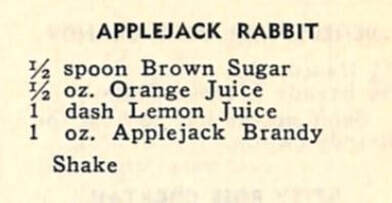
Original recipe from The Roving Bartender, 1946.
The original recipe is as follows:
1/2 spoon brown sugar (I used about half a tablespoon) 1/2 oz. orange juice 1 dash lemon juice 1 oz. applejack brandy Pour over ice in a cocktail shaker and shake for longer than you think you should to make sure the brown sugar is dissolved. Strain into a small cocktail glass, such as martini glass or old-fashioned champagne glass. Sip cold. Virginia Apple Cake Recipe
And, since we talked about historic baking, I thought I would share the recipe for apple cake I found recently in my copy of Virginia Hospitality (1976, my copy is the 1984 reprint). This particular Junior League cookbook is quite good with many of the recipes arranged by region and with decent head notes for many. Alas, this "Apple Cake" has neither headnotes nor region assigned. But it looked intriguingly easy and used up quite a bit of apples.
However, as I discussed in the episode, it really is a strange cake. As such, while I've included a photo of the original recipe, I've written my own version to help walk you through how the recipe should work. 
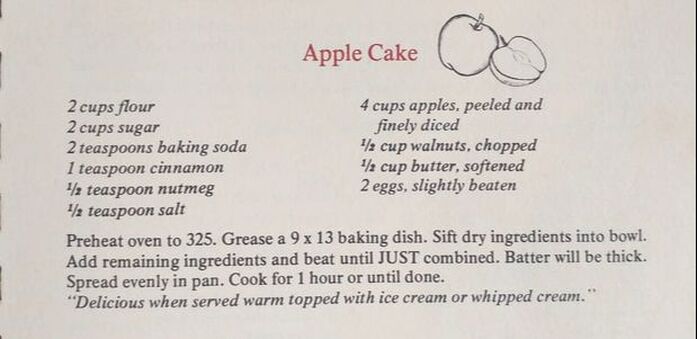
2 cups flour
2 cups sugar 2 teaspoons baking soda 1 teaspoon cinnamon 1/2 teaspoon nutmeg 1/2 teaspoon salt (note - I would add 1 teaspoon next time, the cake tasted a bit "flat") 4 cups apples, peeled and finely diced (about 3 medium apples) 1/2 cup walnuts, chopped 1/2 cup (1 stick) butter, softened 2 eggs slightly beaten Preheat oven to 325 F. Grease a 9"x13" baking dish (I used metal). Whisk dry ingredients in a bowl, then add apples and walnuts and stir to coat. If butter is refrigerated, microwave in 10-15 second intervals until very soft but not totally melted. Add butter and eggs to the dry ingredients and mix/fold with a wooden spoon until no loose flour remains. It will seem like not enough moisture - just keep folding, it will come together. The batter will be very thick. Do not overbeat. Spread evenly in the pan. Bake for 1 hour or until done. (I baked mine for 1 hour and 5 minutes, as the middle still seemed a bit soft). In all, my husband LOVED this recipe, but it was not my favorite. Next time I would definitely add some extra salt as the cake tasted a bit "flat" without it. In retrospect, I also MIGHT have accidentally added 2 teaspoons of cinnamon instead of one? Oops. It was too much cinnamon for me, but as I said, my husband loved it as it reminded him of carrot cake. Baking it for an hour at 325 seemed like way too long, but it did result in nicely caramelized edges (all that sugar). However, all the apples melted into the cake! So next time I would probably cut them a bit bigger. I did almost mince them in some cases. 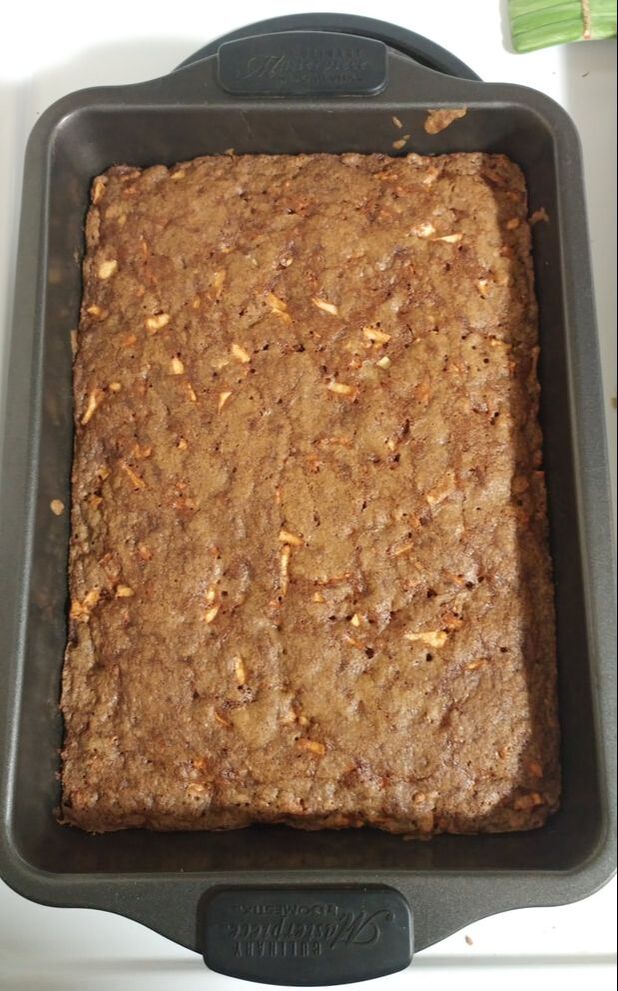
The very brown, caramelized-edge, finished cake!
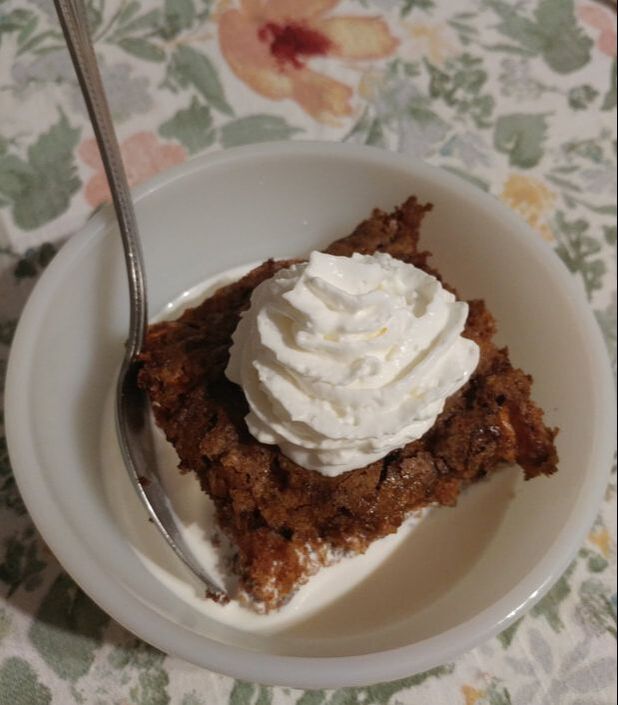
The Instagram-worthy shot. And yes, there is liquid cream in that bowl - the only way to eat cake!
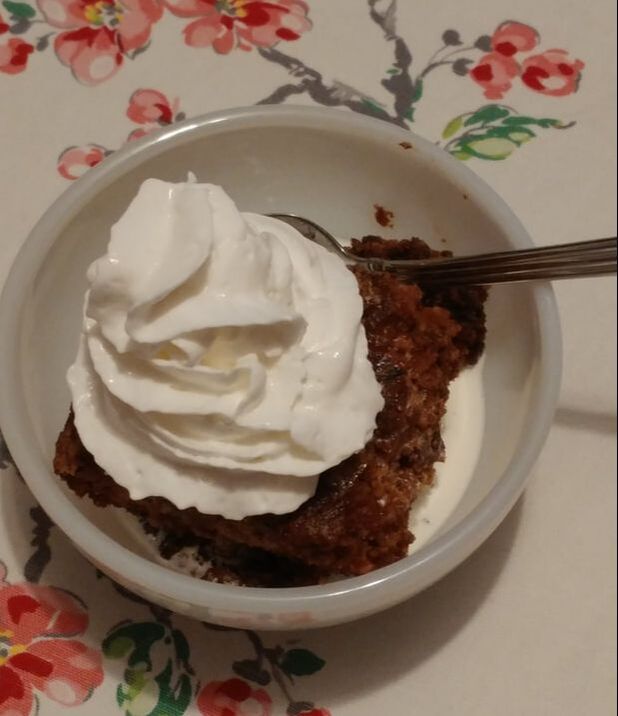
The slightly less Instagram-worthy post-happy hour bedtime snack.
So what did you guys think of this week's episode? Are you going to join me next Friday on Facebook? I hope to see you there! Thanks again to everyone who watched live and remember, if you have any burning food history questions, you can send them to me in advance, message The Food Historian on Facebook, or ask live during the broadcast. See you soon!
If you liked this post and would like to support more Food History Happy Hour livestreams, please consider becoming a member or joining us on Patreon. Members and patrons get special perks like access to members-only content.
The second episode of Food History Happy Hour is now concluded and it was just as fun as the first! This time went both more and less smoothly - less so because I was having technical difficulties with Facebook Live and had to switch to an older version, so that was a bit stressful. More smoothly because lovely friends and Patreon patrons asked some great questions after the first one, so I had some planned topics to discuss. We talked about the cranberry scare of 1959, the origin of the term "comfort food," and the variations on weights and measurements in cooking and baking, as well as forays into the origins of soup, chili, and some discussion of the Spanish Flu pandemic and why I study food history in the First World War.
This week I made a non-alcoholic beverage (to the consternation of some viewers) called the "Florida Special." Although one Facebook fan told me not to make it (conflating it, I think, with "Florida Man"), it sounded too delicious to resist.
The recipe comes from "Recipes for Mixed Drinks" by Hugo R. Ensslin, published in 1917. I did tweak it a bit, as you'll see from the recipe below. 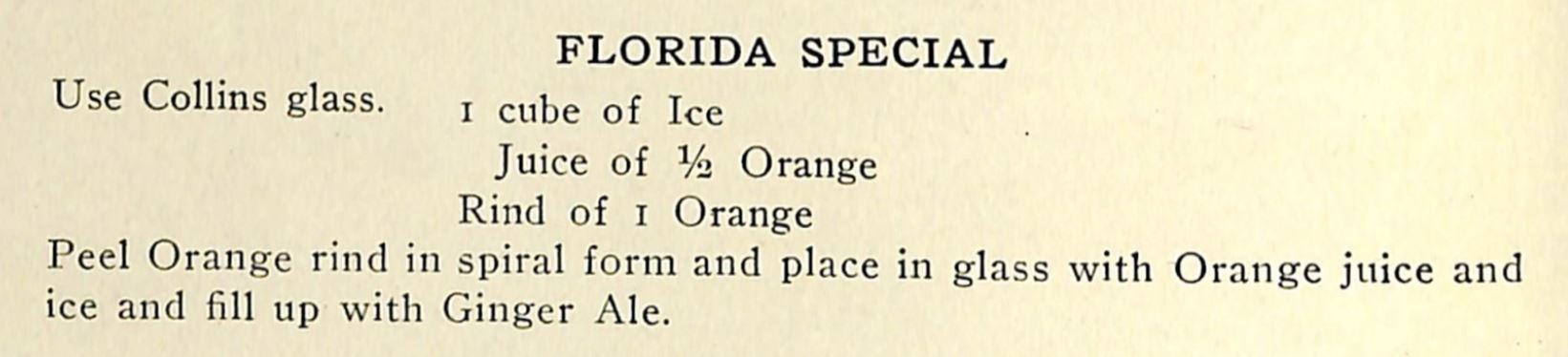
The "Florida Special," as listed under "Miscellaneous Mixed Drinks" from "Recipes for Mixed Drinks," 1917.
Florida Special
2 cubes of ice in a Collins (a.k.a. highball) glass [one just didn't seem enough] rind of 1 orange juice of 1 orange 2-3 dashes orange bitters (optional) ginger ale Using a sharp knife, a supreme knife if you have one, cut the rind from the orange in a single piece and place in the glass. Cut the peeled orange in half and with a citrus press or reamer (or just with your hands), squeeze juice into the glass (if using hands or reamer, be sure to catch any seeds, if there are any). I used my 1940s Juice O'Matic, which I love. Add a few dashes of orange bitters (optional) and fill with ginger ale. Stir well with a straw and enjoy! I found this to be quite delightful, although if you wanted to cut back on the sugar (my orange was quite sweet), it would probably be equally delightful with plain or orange flavored seltzer. I would not recommend substituting bottled orange juice for the fresh, however. It would probably still taste good, but would be a completely different drink. Thanks again to everyone who watched live and I hope to see you all next Friday! Remember, if you have any burning food history questions, you can send them to me in advance, message The Food Historian on Facebook, or ask live during the broadcast. See you soon!
If you liked this post and would like to support more Food History Happy Hour livestreams, please consider becoming a member or joining us on Patreon. Members and patrons get special perks like access to members-only content.
|
AuthorSarah Wassberg Johnson has an MA in Public History from the University at Albany and studies early 20th century food history. Archives
September 2026
Categories
All
|
 RSS Feed